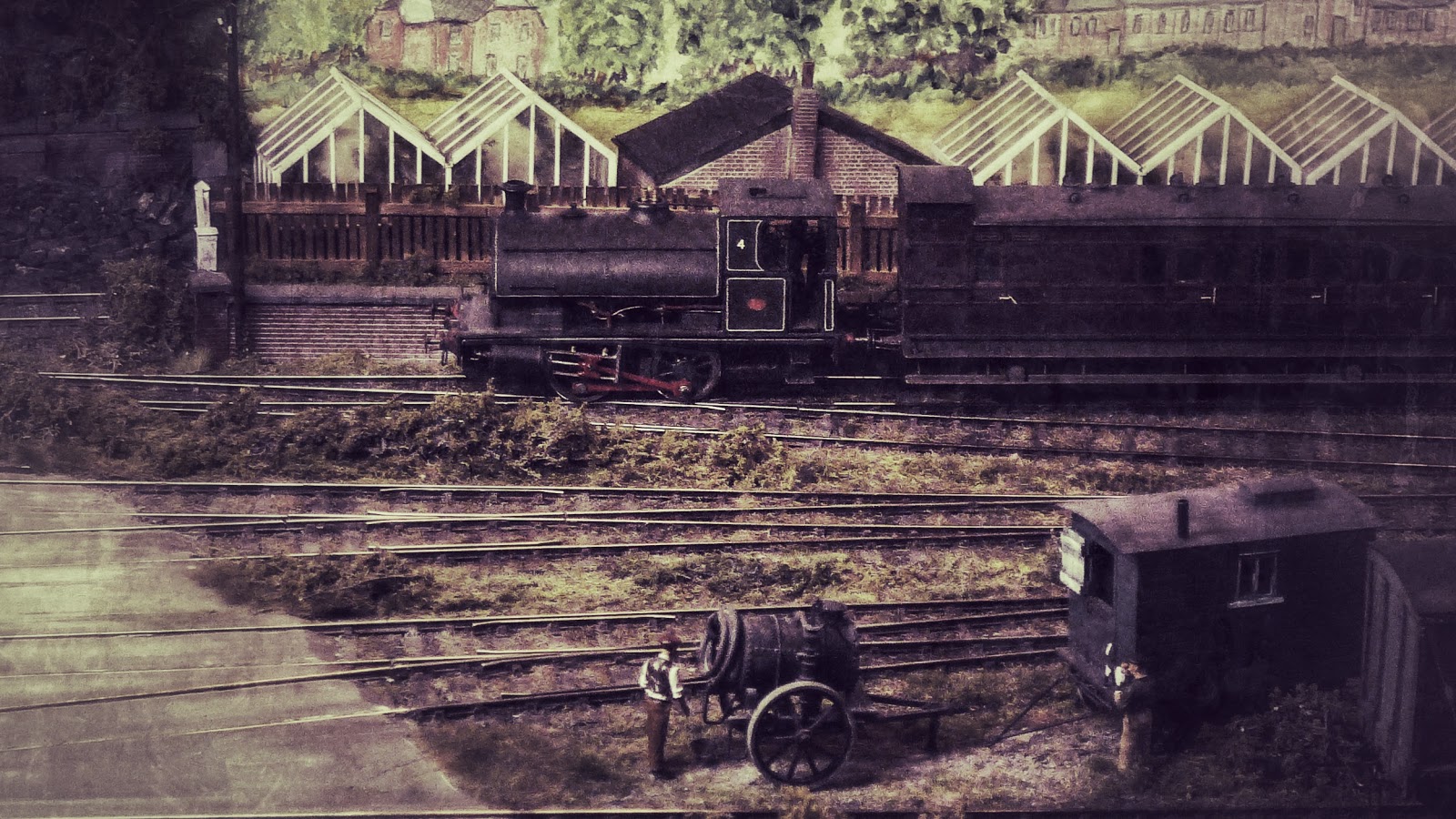
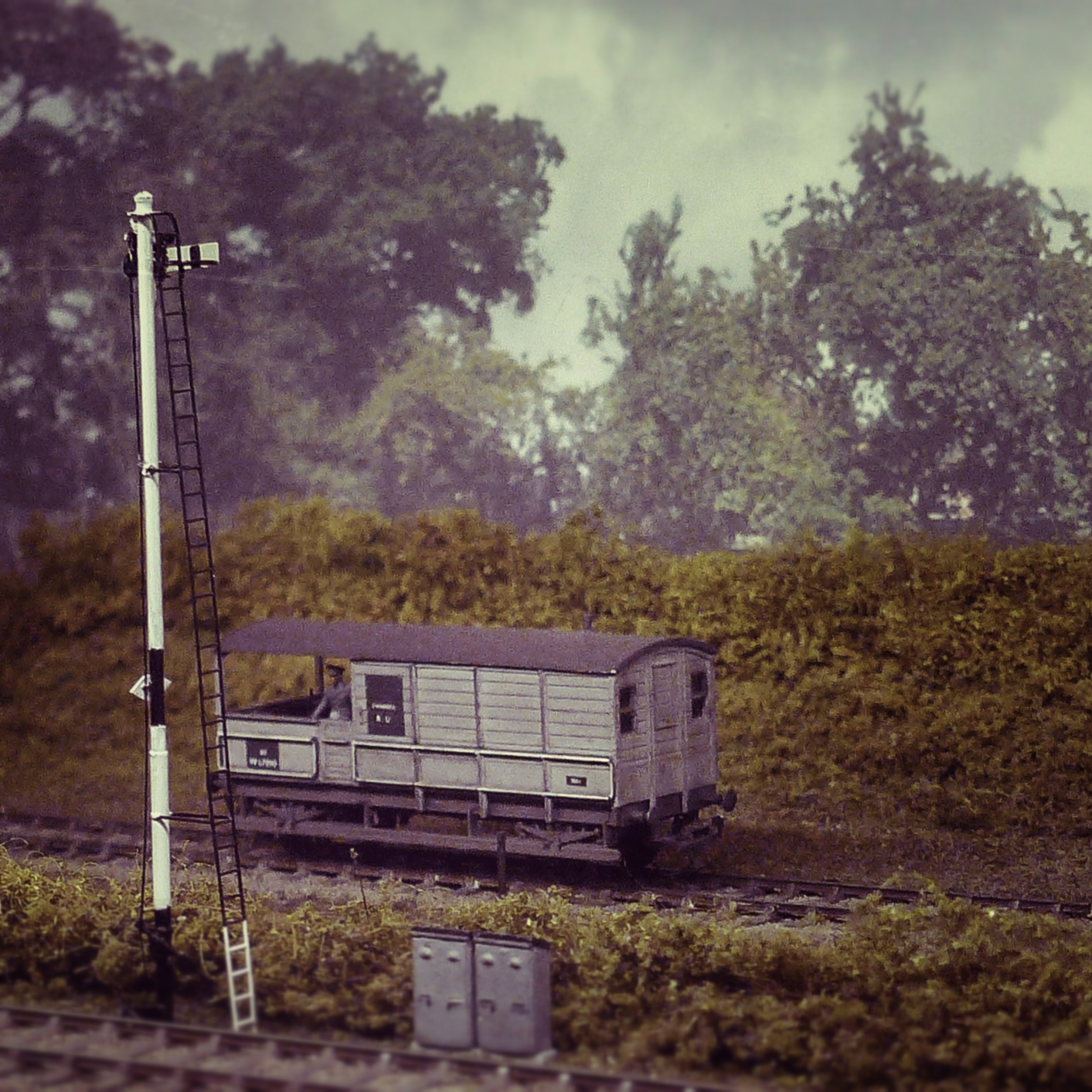
After Covent Garden we whizzed down to north Greenwich and the Emirates Skyline. Those who know me will probably be aware that whilst fortunately I'm a fearless frequent flyer the same can't be said when it comes to heights in general. So you can imagine how chuffed I was to get to the other side only to discover that the DLR wasn't running and we had to go back over the Thames again and take the Jubilee Line.
The knock on effect of this was that I missed visiting the Edwin Smith exhibition that is currently on at RIBA
I made up for this by buying myself the catalogue and a second hand copy of Olive Cook's English Cottages and Farmhouses for which he provided the photographs.
I have to admit that I'd always thought of him as a photographer of the urban landscape and it has come as a bit of a revelation to see his more rural work. Although the book on cottages was published in 1982 the photos date from 1950 to 1971. Both publications are highly recommended.
Moving from an OO gauge micro-layout to an EM gauge compromise, via a rather major diversion into both 7 1/4" gauge and minimal space OO9
Labels
Layout Design
Blodwell
Buildings
The Art of Compromise
Photography
Llanrhaiadr Mochnant
Scenery
Signal Box
Baseboards
Goods Yard
Track
45XX
Apa Box
EM
Lcut Creative
Travel
Backscene
Concepts
Railway Exhibitions
TVR
USA
Upwold
14XX
Anyrail
Bridge
Cuba
Cycling
Fencing
Lorry
Narrow Gauge
Point rodding
Points
Templot
Turnouts
West Maryland
Books
C+L
Fiddleyard
GWR
Hales
OO9
Phil Parker
Rolling Stock
Signals
State of the hobby
Tillig
Warley
Weighbridge
trams
2012
AC Railbus
Albion Yard
Allt-y-Graban Rd
Apa Valley
Balloch Pier
Bas
Bath Green Park
Brickwork
Bridgnorth
Bryn-y-Felin
CSX
Charmouth
Clarendon
Class 25
Cliff Railway
Coldrennick Road
Corris
Crich
DCC
Disused Railways
Dukedog
EMGS
Edwin Smith
Electrics
Emett
France
Gloucestershire & Warwickshire
HO
Hobbies
Hope under Dinmore
Hospital Gates
Iain Rice
Iliffe Stokes
Inspiration
Ireland
Kings Lynn
La Baraque
Lasercut
Leamington & Warwick
Locos
MSTS
Mainly Trains
Military Modeling
Mishaps
N guage
NEC
OOn3
Percy
Pier Railway
Porth y Waen
Preserved Railways
RTR
SMP
Seend
Sentinel
Sketchup
St Minions
Stockholm
TGV
TRAX
Tansey Bank
Techniques
Technology
Tim Horn
Trade
Trees
Ultrascale
Veldhoveh 1935
Watertank
Williamsport
diorama
manning wardle
painting
procrastination
pug
ships
simulators
Showing posts with label Photography. Show all posts
Thursday, 9 October 2014
Tuesday, 24 June 2014
Getting up close
Whilst I'm still getting to know my new "proper" camera, a Fujifilm XE-1 I've also just said goodbye to my old Leica D-Lux compact camera, which has found a new home with my step-daughter.
My compact cameras have a hard life.They usually live in my pocket or thrust into a bag and get used pretty much every day. The D-Lux has stood up to it well, and bears the scars to show it. In four years it has only let me down once. It sits in the select group of compact cameras I've owned that produced photos that punched above their weight.
However, technology moves on, and earlier this year I realised that I was using the camera on my Galaxy S4 phone more than the D-Lux, even when I had the D-Lux with me, as on the Crich grice.
With a lot of travel planned for the rest of this year I decided it was time for a new travel camera. As usual I went for last year's model to get a good price, and opted for the Panasonic TZ40 I've been using Panasonic compact cameras for ten years now and they've all been good. Even the D-Lux is a Panasonic under the Leica branding.
After the D-Lux, it does feel rather light and plasticky and although it promised a massive 20x zoom range I wasn't expecting most of that range to be usable. It has built in GPS, which I find useful when taking photos on cycling trips and WiFi, which perhaps is a bit of a gimmick.
Or is it?
One thing you can do is link it with your mobile phone and as well as using it as a remote viewfinder and shutter release you can also use the phone to operate most of the other camera functions. Combined with a surprisingly good macro capability and touch screen focusing this suddenly opens up the possibility of taking some interesting layout shots with the camera crammed into otherwise inaccessible positions. Like this one taken with the camera right against the backscene.
I'm still getting to grips with it as a general purpose camera, in particular trying to work out the limits where image quality starts to suffer. The large zoom range is more usable than expected, thanks to good image stabilisation. In fact in good light even the further extended "digital zoom" is usable sometimes. On the downside low light performance isn't anything to write home about, and the in-camera processing of the JPEGs is a bit extreme for my liking, especially since saving images in RAW isn't possible.
Although as usual I went for a camera that allows full manual override I have been very impressed with the Intelligent Auto setting that chooses settings for you and I'm beginning to trust it. Oddly using the XE-1 I find myself setting everything but ISO to manual but I'm not proud and don't mind using automatic settings when they are available.
All in all I'm relatively pleased with it, whilst sad to see the D-Lux go.
My compact cameras have a hard life.They usually live in my pocket or thrust into a bag and get used pretty much every day. The D-Lux has stood up to it well, and bears the scars to show it. In four years it has only let me down once. It sits in the select group of compact cameras I've owned that produced photos that punched above their weight.
However, technology moves on, and earlier this year I realised that I was using the camera on my Galaxy S4 phone more than the D-Lux, even when I had the D-Lux with me, as on the Crich grice.
With a lot of travel planned for the rest of this year I decided it was time for a new travel camera. As usual I went for last year's model to get a good price, and opted for the Panasonic TZ40 I've been using Panasonic compact cameras for ten years now and they've all been good. Even the D-Lux is a Panasonic under the Leica branding.
After the D-Lux, it does feel rather light and plasticky and although it promised a massive 20x zoom range I wasn't expecting most of that range to be usable. It has built in GPS, which I find useful when taking photos on cycling trips and WiFi, which perhaps is a bit of a gimmick.
Or is it?
One thing you can do is link it with your mobile phone and as well as using it as a remote viewfinder and shutter release you can also use the phone to operate most of the other camera functions. Combined with a surprisingly good macro capability and touch screen focusing this suddenly opens up the possibility of taking some interesting layout shots with the camera crammed into otherwise inaccessible positions. Like this one taken with the camera right against the backscene.
I'm still getting to grips with it as a general purpose camera, in particular trying to work out the limits where image quality starts to suffer. The large zoom range is more usable than expected, thanks to good image stabilisation. In fact in good light even the further extended "digital zoom" is usable sometimes. On the downside low light performance isn't anything to write home about, and the in-camera processing of the JPEGs is a bit extreme for my liking, especially since saving images in RAW isn't possible.
Although as usual I went for a camera that allows full manual override I have been very impressed with the Intelligent Auto setting that chooses settings for you and I'm beginning to trust it. Oddly using the XE-1 I find myself setting everything but ISO to manual but I'm not proud and don't mind using automatic settings when they are available.
All in all I'm relatively pleased with it, whilst sad to see the D-Lux go.
Sunday, 9 March 2014
A Jolly Good Show
I like Stoneleigh as an exhibition venue. I miss the Assoc of 16mm modellers show not being held there. Compared to many venues space never seems to be an issue and the catering is quite good. It also hold many many memories from the days of the Royal Show and trips on the original Echills Wood Railway.
There were some good layouts this year. As usual the lighting was a challenge and once again I was aware when taking photographs of the lack of decent backscenes.
I was rather taken with Earls Court, a layout I've wanted to see for a long time and which really makes the best use of a limited space. The real attraction for me though is the modelling of the shops, like the barbershops above, which I've kept in colour because it reminded me of an Edward Hopper painting.
Loch Tat is one of those layouts that I always think would benefit from being displayed at a higher level where individual scenes like these would predominate over the birds eye view.
Staying with 2mm scale I probably should have spent more time watching Wansbeck Road
Moving up to 7mm Weydon Road had some nice set piece scenes
I've been known to admit being tempted by an American HO layout one day. If I ever did go down that route I think it would be something like Wiley City. The prototype is rather endearing and the modelling really showed HO in a good light by being suitably restrained.
Lack of restraint is still one of the things that I find spoils the illusion of reality for me, and there were a few layouts at the show that simply didn't know where to stop. Eaton Gomery for example is one of those layouts where you struggle to find a scene that looks like everyday life and not like a historic reenactment on a preserved railway.
On the other hand I can see why people would find Foundry Lane a little too plain. I don't think it was helped at this show by lighting that didn't bring out the texture of the retaining walls.Personally I liked it a lot.
Richmond was exquisite and provided an opportunity for my favourite shot, looking down the track through a station. Unfortunately I failed to notice when taking it that someone's hand was very visible fiddling about in the fiddle yard, so instead it is represented by my alternative trademark cliche, the solitary Toad.
I was also very taken with the trackwork on Bodmin. This is what I would like to aspire to.
Ah yes, talking of trackwork...the nice thing about a show like this is that unlike Warley you can actually get close to some of the trade stalls. That means I came away with everything I had on my shopping list, including a replenished supply of C+L bits and pieces so turnout construction can resume as soon as my EMGS jigs arrive.
I also got a chance to chat with the extremely helpful Geoff from Comet and as a result my to do box now contains their chassis kit for the 57XX.
Last but not least I picked up a copy of Marcher Railways from Roger Carpenter and three postcards of the Tanat Valley that I'd not seen before.
If you want to see some more shots in colour then I did manage to make some of them presentable
Thursday, 22 August 2013
The Grass Grows
I wasn't happy with the grass on the disused platform. Checking back to a photo of Blodwell Junction suggests in real life it the grass was a lot longer and the bushes had encroached a lot more.
So it was out with the Noch static grass again this lunchtime to try and improve the look of things.
I It looks a bit better than this in the flesh. However I do find static grass always ends up looking much lighter than I expect. I still need to add some bushes on the platform, and the join between the grass and the platform edge seems to have become move obvious.
I've added some vegetation at track level as well but that needs cutting back once the glue has dried if only to clear the point rodding. Ah yes, the point rodding. The MSE version is so delicate my eyes have to look for it in the photos of the model, whereas it is very prominent in prototype photos.
So it was out with the Noch static grass again this lunchtime to try and improve the look of things.
![]() |
| This is one of my favourite shots of the layout to date. |
I It looks a bit better than this in the flesh. However I do find static grass always ends up looking much lighter than I expect. I still need to add some bushes on the platform, and the join between the grass and the platform edge seems to have become move obvious.
I've added some vegetation at track level as well but that needs cutting back once the glue has dried if only to clear the point rodding. Ah yes, the point rodding. The MSE version is so delicate my eyes have to look for it in the photos of the model, whereas it is very prominent in prototype photos.
Saturday, 17 August 2013
The Bridge
I really need to darken both the brickwork and the stone. I've also decided I couldn't live with the crude windows in the weighbridge hut. So my question is how do you best remove Glue N Glaze? It seems to be resisting all my efforts to clean the last bits away from around the edges.
Monday, 12 August 2013
Still more photos
OK, I'm feeling quite pleased with myself after this weekend's final push.there are still quite a few jobs to do, but most of them are the sort that can be done in a spare five minutes.
Hedging
Just in case you think I spent the whole weekend pontificating rather than modeling.
The hedge is now in place, made from teased out hanging basket liner, sprayed and then sprinkled with foam.
The platform now has a covering of static grass to reflect its disused status, though I'm disappointed that it has come out very bland compared to my test piece, so I need to revisit it. I've also re-foliaged a so-called premium tree.
I suspect I need to build a new version of the weighbridge hut. The window looks OK in the flesh but is revealed as terribly crude in photos.
Talking of which, here are some more photos:
The hedge is now in place, made from teased out hanging basket liner, sprayed and then sprinkled with foam.
The platform now has a covering of static grass to reflect its disused status, though I'm disappointed that it has come out very bland compared to my test piece, so I need to revisit it. I've also re-foliaged a so-called premium tree.
I suspect I need to build a new version of the weighbridge hut. The window looks OK in the flesh but is revealed as terribly crude in photos.
Talking of which, here are some more photos:
Saturday, 3 August 2013
Friday, 2 August 2013
Derailed
I was quite pleased with the vintage effect on this photo, especially since it was both shot and edited on my Samsung S3 phone, using Snapseed.
Of course it was only when I transferred the file to the PC that I realised we'd had a bit of a derailment.
Wednesday, 31 July 2013
Backscene in Place
So late last night I finally plucked up courage to put in the "proper" backscene.
For an off the shelf commercial product I think it fits quite well with the layout. I messed up the clearance for the lid, which means it is best not viewed from low angles, and as the photos show I need to roller over it again to get rid of a couple of ripples that emerged as I bent it to fit. Overall though I'm pleased with the result. It looks better in the flesh than in the photos.
With the backscene in place I can now start adding the real scenic work, starting from the back of the diorama and working to the front.
For an off the shelf commercial product I think it fits quite well with the layout. I messed up the clearance for the lid, which means it is best not viewed from low angles, and as the photos show I need to roller over it again to get rid of a couple of ripples that emerged as I bent it to fit. Overall though I'm pleased with the result. It looks better in the flesh than in the photos.
Thursday, 25 July 2013
Mud
It seems a long time since I've had a week that was quiet enough at work to allow for me to be home in the evenings.
I did, however, manage to get something like a lunch hour today. Like as in it was only half an hour and I didn't get a chance to eat lunch, but since I was working from home I did get a couple of jobs done on the layout.
So the platform is now surfaced and the goods yard is ...well still not right. I'm struggling with the very simple question of what a muddy goods yard should actually look like.
I did, however, manage to get something like a lunch hour today. Like as in it was only half an hour and I didn't get a chance to eat lunch, but since I was working from home I did get a couple of jobs done on the layout.
So the platform is now surfaced and the goods yard is ...well still not right. I'm struggling with the very simple question of what a muddy goods yard should actually look like.
Sunday, 25 November 2012
Warley 2012
The Warely model railway show at the NEC has become something of an institution. The Warley club who organise it have always built excellent layouts themselves, and from the days when I was a lad in Birmingham and the show was held in the Harry Mitchell Recreation Centre it has attracted some stunning and memorable layouts.
I don't go every year, not least because I do find my fellow enthusiasts a rather unappealing crowd with their body odour, beer bellies, rucksacks, lack of social awareness and dubious fashion sense. Sorry, but that is how it is. In recent years I've also found the standard of the layouts more variable. I suspect in part though this is because the general standard of modelling has improved so much, and the model railway press do such an excellent job of showing layouts in their best possible light that itmakes it hard for them to live up to expectations.
I point this out because when captioning photos on my Flickr photostream for the show I couldn't help feeling I was being very negative. On reflection I think it was because I was subjecting the layouts to the sort of scrutiny I'm giving to my own efforts and also it makes a difference viewing a layout through the lens of a camera - you become very aware of those things that destroy the illusion of reality. Incidentally if the crowds round some of the layouts were anything to go by my view of some of the layouts wasn't shared by the majority.
So what follows is a very personal view, and isn't intended to be derogatory in any way.
Lets Do The Time Warp Again
Having mentioned how much modelling has improved in the last thirty years it is disappointing to see elements that wouldn't have looked out of place on the typical Railway of the Month from the 1960s. Topping that list has to be trees made from lichen, poor back-scenes and obvious straight line baseboard joins.
Sadly the one layout I really went to the show to see, Hospital Gates, suffered badly from both the baseboard joint issue and a back-scene that didn't integrate well with the modelled portion of the layout.
It was a real pity, because clearly a lot of thought had gone into the backscene, and it had been painted with considerable skill and thought. Overall this is a great layout but one that struggles to live up to published photographs of it.
Incidentally Bath Green Park was another layout which I felt had a mismatched style of backscene despite trying to recreate a realistic sky line.I found it quite distracting on an otherwise stunning layout,
Photos v. the Real World v. Exhibition Halls
It really is a lot easier to build a layout to be convincing to the camera in individual shots than to be convincing to the human eye taking in the whole layout from an unlimited number of angles. Two of the best continental layouts on display, the well known Veldhoveh 1935 and the new to me La Baraque addressed this by careful presentation and control of the eyeline to ensure cameos attracted the attention rather than the whole layout.
Both these layouts take a novel approach, Veldhoveh's is very theatrical and involves forced perspective with buildings (and trams) in dufferent scales
La Baraque is designed to be viewed in the round, and this seemed very popular. It does lead to a few odd visual problems where the backscene doesn't extend across the whole of your line of vision.
The conclusion I walked away with is that proper framing is vitally important, and too many layouts don't take it into account. Again I could be being a little unfair because framing might be more evident in the rooms they normally live in where they are observed from a more restricted space.. There is no doubt that a large exhibition hall like the NEC distorts things spatially. 4mm and even 7mm stock seems to shrink which means you don't get a feel for just how big some of the layouts on display are.
Another challenge of the exhibition hall is lighting. It is one of the reasons most of my photos from the show have been subjected to more post processing than I normally indulge in. You get a real mix of lighting sources that can distort colour not only in photos but to the eye as well. Most layouts at the show recognised the importance of lighting but in counteracting the hall lighting the effect achieved was more often than not that of a Summer's day in India rather than a typical British day. The only days I saw any sunshine this year were on my trips to India.
Because my photo blog is currently based around using a compact camera for a year I used the trusty D-Lux for all these shots. The DSLR with a decent prime would have been my camera of choice. As always photographers were out in force, and as always I found myself wondering about the type of photos people were taking and what they were intending to do with them.
Cars and Boats and Planes
The standard of boats on most layouts has improved enormously over the years, and you had to be impressed by Maid of the Loch on Balloch Pier
Along with the improvement with the boats has come some staggeringly good modelling of water in different states, like this scene on Coldrennick Road.
When it comes to road transport though there is something I don't understand. The basic quality of cars and lorries available to the 4mm scale modeller in particular is everything you could ask for, yet on layout after layout they stick out like a sore thumb. Why? Sometimes it is because the model has become a bit of a cliche, sometimes it is the finish, often even attempts to improve realism seem to have the opposite effect - especially anything involving chrome - and perhaps above anything else there is something about how they are placed on the layout. This I think can probably be divided into two elements: How they are posed to look natural, which to me means looking like they've been parked by a human driver, and secondly how they "sit" on the layout.
At the moment this is putting me off any plans to put a lorry on my layout, even though several photos I have of the Tanat Valley in the period feature them.
As for planes...well just don't, they never work.
Operation
It wasn't until I got home that it struck me that I'd hardly bothered to watch any of the layouts actually operating. I suspect that this is because operation isn't going to be a major feature of Apa, and the layouts that most caught me eye worked just as well, if not better, without a train in sight, like Bryn-y-Felin
For me perhaps another element is at play, that I can best sum up as "involvement" A couple of layouts were finely observed and exquisitely modelled but didn't grab me in any way emotionally. Hope Under Dinmore is a good example.
And the Winner is...
I want to stress again that I've emphasised the negatives because they are things I want to avoid myself, and that I'm aware my tastes might not be mainstream. I'm sure many would have gone for Liverpool Lime St, Bath Green Park or Hospital Gates. I've already said how good I thought Veldhoveh and La Baraque were.
If you go by the number of photos I took then the old charmer that is Charmouth was a clear winner.
When I go by the time I spent just looking at a layout though, then the winner is the one that made me think "Yes, that's what I'm trying to achieve" and on that criteria the prize goes to Allt-y-Graban Rd. This might be bad news because on that basis I might have to widen my gauge a little.
I don't go every year, not least because I do find my fellow enthusiasts a rather unappealing crowd with their body odour, beer bellies, rucksacks, lack of social awareness and dubious fashion sense. Sorry, but that is how it is. In recent years I've also found the standard of the layouts more variable. I suspect in part though this is because the general standard of modelling has improved so much, and the model railway press do such an excellent job of showing layouts in their best possible light that itmakes it hard for them to live up to expectations.
I point this out because when captioning photos on my Flickr photostream for the show I couldn't help feeling I was being very negative. On reflection I think it was because I was subjecting the layouts to the sort of scrutiny I'm giving to my own efforts and also it makes a difference viewing a layout through the lens of a camera - you become very aware of those things that destroy the illusion of reality. Incidentally if the crowds round some of the layouts were anything to go by my view of some of the layouts wasn't shared by the majority.
So what follows is a very personal view, and isn't intended to be derogatory in any way.
Lets Do The Time Warp Again
Having mentioned how much modelling has improved in the last thirty years it is disappointing to see elements that wouldn't have looked out of place on the typical Railway of the Month from the 1960s. Topping that list has to be trees made from lichen, poor back-scenes and obvious straight line baseboard joins.
![]() |
| Nice wagons, shame about the trees |
Sadly the one layout I really went to the show to see, Hospital Gates, suffered badly from both the baseboard joint issue and a back-scene that didn't integrate well with the modelled portion of the layout.
It was a real pity, because clearly a lot of thought had gone into the backscene, and it had been painted with considerable skill and thought. Overall this is a great layout but one that struggles to live up to published photographs of it.
Incidentally Bath Green Park was another layout which I felt had a mismatched style of backscene despite trying to recreate a realistic sky line.I found it quite distracting on an otherwise stunning layout,
Photos v. the Real World v. Exhibition Halls
It really is a lot easier to build a layout to be convincing to the camera in individual shots than to be convincing to the human eye taking in the whole layout from an unlimited number of angles. Two of the best continental layouts on display, the well known Veldhoveh 1935 and the new to me La Baraque addressed this by careful presentation and control of the eyeline to ensure cameos attracted the attention rather than the whole layout.
![]() |
| Veldhoveh - almost like being there |
![]() |
| La Baraque had a touch of the Madder Valley about it |
Both these layouts take a novel approach, Veldhoveh's is very theatrical and involves forced perspective with buildings (and trams) in dufferent scales
![]() |
| That is what a model railway backscene should look like |
La Baraque is designed to be viewed in the round, and this seemed very popular. It does lead to a few odd visual problems where the backscene doesn't extend across the whole of your line of vision.
The conclusion I walked away with is that proper framing is vitally important, and too many layouts don't take it into account. Again I could be being a little unfair because framing might be more evident in the rooms they normally live in where they are observed from a more restricted space.. There is no doubt that a large exhibition hall like the NEC distorts things spatially. 4mm and even 7mm stock seems to shrink which means you don't get a feel for just how big some of the layouts on display are.
Another challenge of the exhibition hall is lighting. It is one of the reasons most of my photos from the show have been subjected to more post processing than I normally indulge in. You get a real mix of lighting sources that can distort colour not only in photos but to the eye as well. Most layouts at the show recognised the importance of lighting but in counteracting the hall lighting the effect achieved was more often than not that of a Summer's day in India rather than a typical British day. The only days I saw any sunshine this year were on my trips to India.
Because my photo blog is currently based around using a compact camera for a year I used the trusty D-Lux for all these shots. The DSLR with a decent prime would have been my camera of choice. As always photographers were out in force, and as always I found myself wondering about the type of photos people were taking and what they were intending to do with them.
Cars and Boats and Planes
The standard of boats on most layouts has improved enormously over the years, and you had to be impressed by Maid of the Loch on Balloch Pier
![]() |
| The choice was cut off the mast or show another prematurely truncated back scene |
Along with the improvement with the boats has come some staggeringly good modelling of water in different states, like this scene on Coldrennick Road.
![]() |
| The illusion of depth here was ruined as soon as a train was in the frame |
When it comes to road transport though there is something I don't understand. The basic quality of cars and lorries available to the 4mm scale modeller in particular is everything you could ask for, yet on layout after layout they stick out like a sore thumb. Why? Sometimes it is because the model has become a bit of a cliche, sometimes it is the finish, often even attempts to improve realism seem to have the opposite effect - especially anything involving chrome - and perhaps above anything else there is something about how they are placed on the layout. This I think can probably be divided into two elements: How they are posed to look natural, which to me means looking like they've been parked by a human driver, and secondly how they "sit" on the layout.
At the moment this is putting me off any plans to put a lorry on my layout, even though several photos I have of the Tanat Valley in the period feature them.
As for planes...well just don't, they never work.
Operation
It wasn't until I got home that it struck me that I'd hardly bothered to watch any of the layouts actually operating. I suspect that this is because operation isn't going to be a major feature of Apa, and the layouts that most caught me eye worked just as well, if not better, without a train in sight, like Bryn-y-Felin
![]() |
| Just add rain |
For me perhaps another element is at play, that I can best sum up as "involvement" A couple of layouts were finely observed and exquisitely modelled but didn't grab me in any way emotionally. Hope Under Dinmore is a good example.
And the Winner is...
I want to stress again that I've emphasised the negatives because they are things I want to avoid myself, and that I'm aware my tastes might not be mainstream. I'm sure many would have gone for Liverpool Lime St, Bath Green Park or Hospital Gates. I've already said how good I thought Veldhoveh and La Baraque were.
If you go by the number of photos I took then the old charmer that is Charmouth was a clear winner.
When I go by the time I spent just looking at a layout though, then the winner is the one that made me think "Yes, that's what I'm trying to achieve" and on that criteria the prize goes to Allt-y-Graban Rd. This might be bad news because on that basis I might have to widen my gauge a little.
![]() |
| Allt-y-Graban Road. Picture perfect |
Subscribe to:
Posts (Atom)