Showing posts with label Warley. Show all posts

Sunday, 24 November 2013

Warley 2013 - Or Bye, Bye, Albion Yard.

Why do we go to model railway exhibitions?

Can someone remind me which layout this is?

I wonder how many answers there are to that question, and also how many of them survive close scrutiny.

I think the most honest answer I got today was from the chap who'd come up from Devon for the day and claimed, when I met him in mid afternoon, not to have seen a single layout because he'd spent so long chatting to people.

It is purely coincidental that I met him at the bar, and that they had run out of anything that might be properly considered beer.

I'm still thinking of my own answer.

In the past I'm fairly certain I would have said it was to see for myself layouts I'd been impressed by  in magazines, and to learn from other modelers.

There is still an element of truth in both of those points, though I've lost count of the times I've been disappointed by a layout that looked stunning in carefully stage designed photos and many times in the past any learning I've done has been by observation, not by engaging in anything more than the most superficial conversation.

I have to say that I find operators more and more willing to chat as I get older. I wonder if that is because layouts have become generally more reliable giving the operators more bandwidth, or if it is a generational thing. Certainly the heritage layout on display seemed to involve so much effort to operate that interaction with the audience was non-existent. Incidentally where but at a show like this would I get a chance to spend fifteen minutes discussing my tyro point building fears with Norman Solomon?

Show are also a great place to pick up bits and pieces from specialist traders, especially those small items that would attract relatively high p&p charges. Most of my purchases were related to track building and the switch to S&W couplings. What I forgot to buy were the underfloor bits and bobs for the MK1 coach. It was good to meet the people behind Lcut Creative as well, and to discuss their design philosophy.

It is easy to forget that a perfectly acceptable reason to go is to actually enjoy just looking at the layouts. I have to say though that every year I go to Warley I get the feeling the layouts I most enjoy watching aren't the ones that appeal to the masses.

So what about the layouts this year?

Frankly I thought they were disappointing. So rather than last year's quite comprehensive review I'm going to focus on three layouts in particular, with a few honourable mentions for others.

Let me get the three negatives out of the way first.

Paul's pre-Warley blog about backscenes should  have printed out and handed to the builders of most of the layouts at the show. The lighting at the NEC is interesting at the best of times, but when combined with a lack of decent backscenes it makes photography a real chore. Hence many of the photos that follow are tightly cropped, and I've converted them all into black and white.  I'm not sure whether no backscene is better or worse than a bad backscene that looks like an afterthought. This isn't just about photography either. It is hard to immerse yourself in a layout when distracted by things in the background.

Secondly, is it now compulsory to have so many working lights scattered around a layout, all set at maximum intensity so that it looks like a Xmas tree?

Thirdly why do layouts have to be crammed full of cameos and things going on? Mike Cougill wrote a thoughtful piece on the power of empty recently.

Selsey was a good example of this. I really struggled to find a shot that didn't include something that I was meant to find interesting or amusing. Every individual item was modeled to an impressive standard but the sum was less than the parts. I eventually found an area at the back of an engine shed that was relatively low key.


The OO9 Glyn Valley Tramway layout demonstrated this tendency as well. This is a line close to my heart and has been on my to do list in O16.5 ever since Stephen Poole bought out what is now the Peco GVT loco kit, and Roy Link published his GVT in 8'x10' plan in the Modeller. This layout caught some of the atmosphere quite well, but wherever you looked there wasn't just one thing going on but several. and the overall impact went from being a model of a prototype location to being just another hackneyed OO9 layout. Again I managed to get just one shot that avoided the worst excesses. Even so a traction engine and a steam lorry are in shot, though the horses don't seem bothered.


Cameos can work. Take this for example from one of the layouts whose name I've forgotten. Though even then I think it only needed one of the two pairs of figures to be effective. Don't get me started on extremely low relief factory buildings as backdrops.


Rolvendon at least used the cameos to evoke a time and place, as with the hop growing scene.


At times wandering around the layouts I thought it was like so much that has been achieved in the last thirty years has been forgotten. At the same time it was sad to hear so many people dismissing Borchester Market on the grounds that "anyone could do that now". I don't think in its current condition the layout quite captures the full Dyer legacy, but the one thing it clearly does is represent a working railway.


A good example of what the typical modeler of today could expect to produce was the simple Aldbury Town, although if you are going to use P4 I would query the use of so many kit built buildings


In the past those of us in the UK used to envy continental modelers the quality of the out of the box products they had available, but deride their toy train approach to layouts. Year after year I think Warley shows how outdated that view is and as usual many of the layouts I spent longest  looking at were not of or from the UK.


I was particularly impressed with  aspects of Thanasee-Cabusart although it was hampered by the narrowness of the baseboards.


Now for the three layouts that I went back to time after time. Conveniently two of them were co-located, and not only that they were models of the same prototype. I'm referring, of course, to Peter Kazer's Corris, and Rod Allcock's OO9 Corris 1930. I still remember how blown away I was when I first saw Peter's model and in many ways I think it is still one of the finest narrow gauge layouts ever built. But gosh, how it needs a backscene when at an exhibition like this. Rod's version, and his locos, show how OO9 has matured and is a brilliant interpretation of the real life Corris to make a visually appealing layout. It is a pity they were forming two sides of an L so it wasn't possible to see them both together at the same time. Had I been more structured I would have tried to take  similar views of both layouts for a comparison. Peter's version dominates the photos simply because it was easier to get up close to.


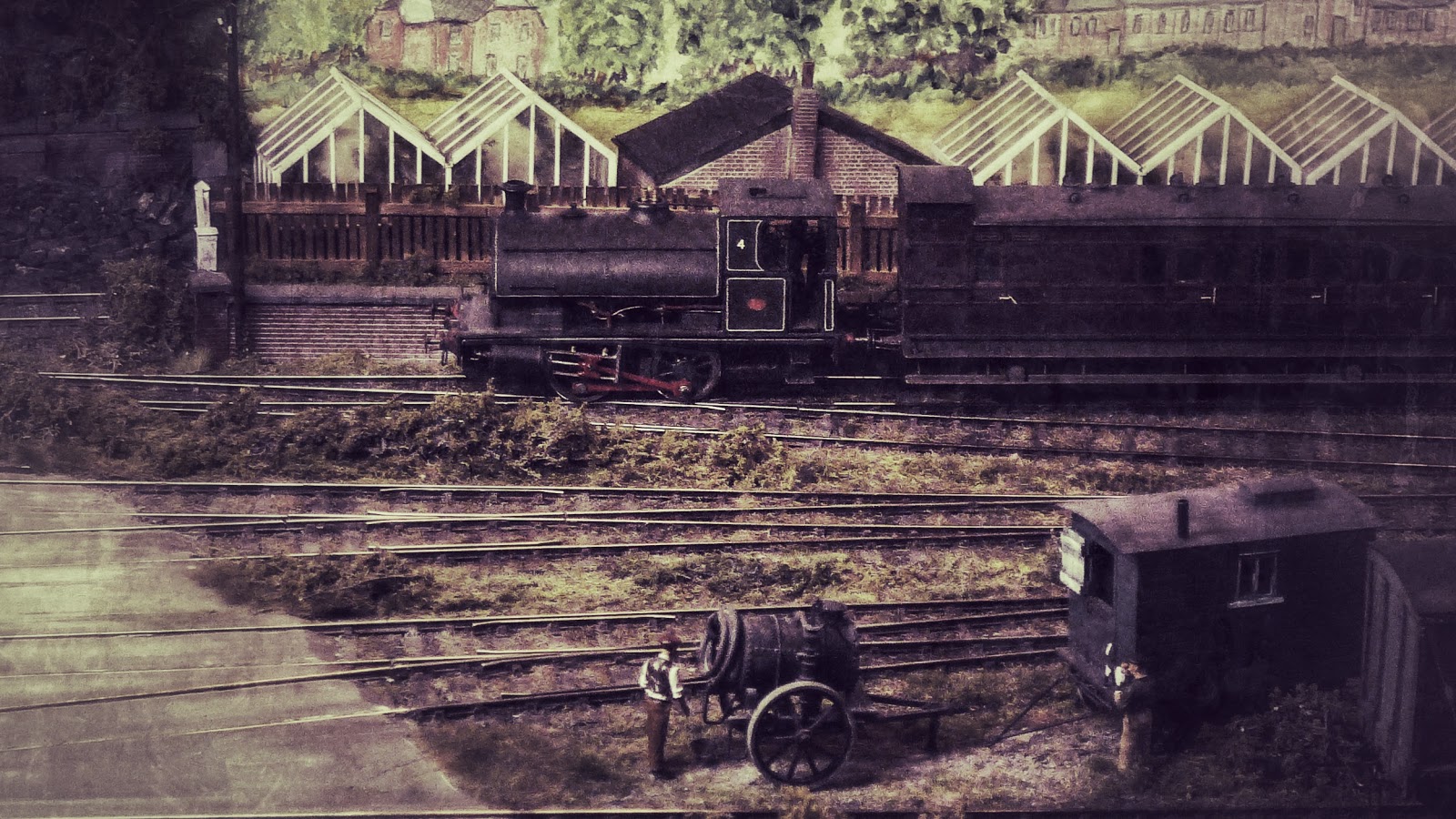
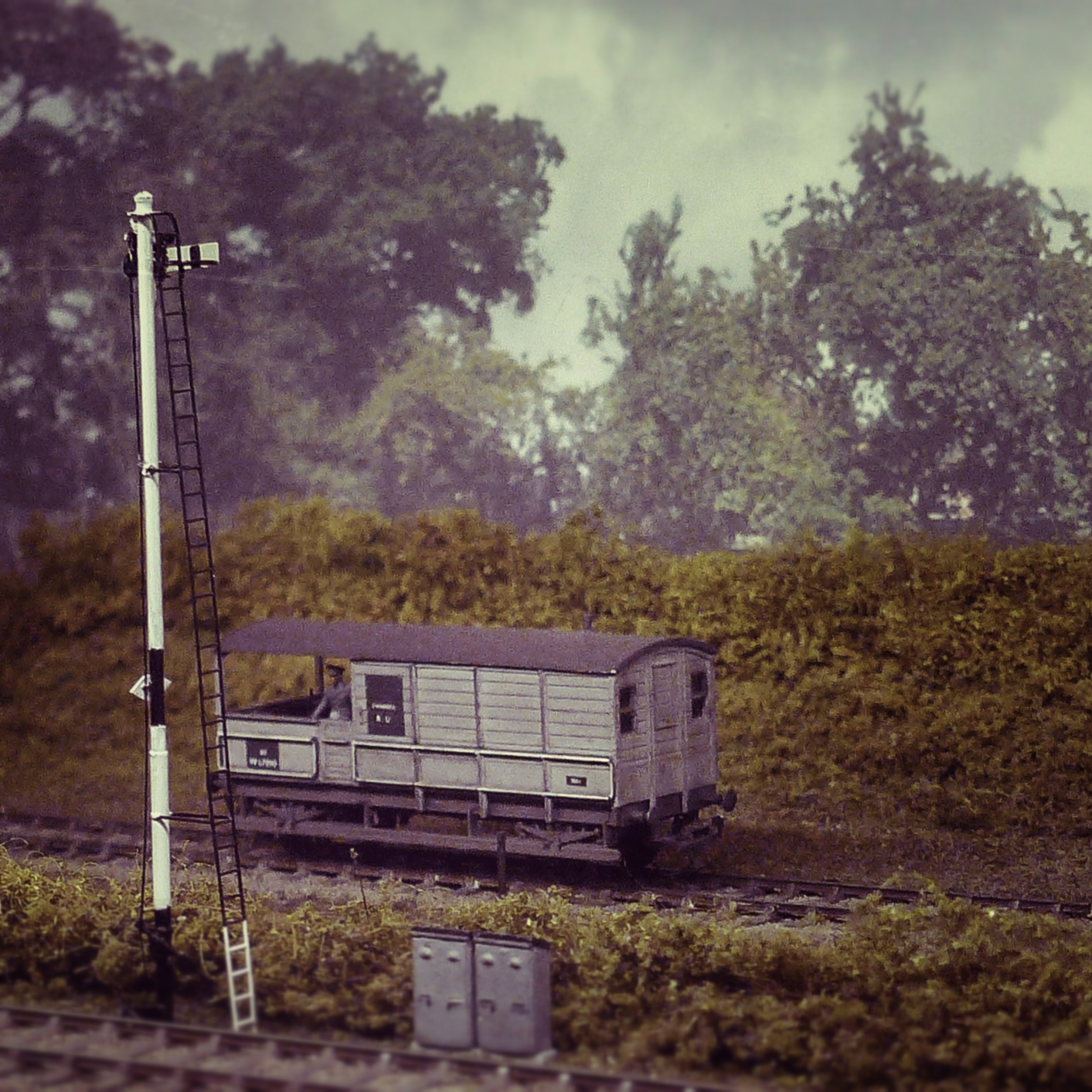
So that leaves one layout to discuss, which was my favourite of the show, and the title of this post has already given that away. Since this was supposedly its last appearance I've left it quite late to see Albion Yard  for the first time. I'm glad to see it lived up to my expectations . When a layout is already so well photographed you might question the point of trying to take photos of it in the less than ideal conditions of an exhibition hall. But I couldn't resist!
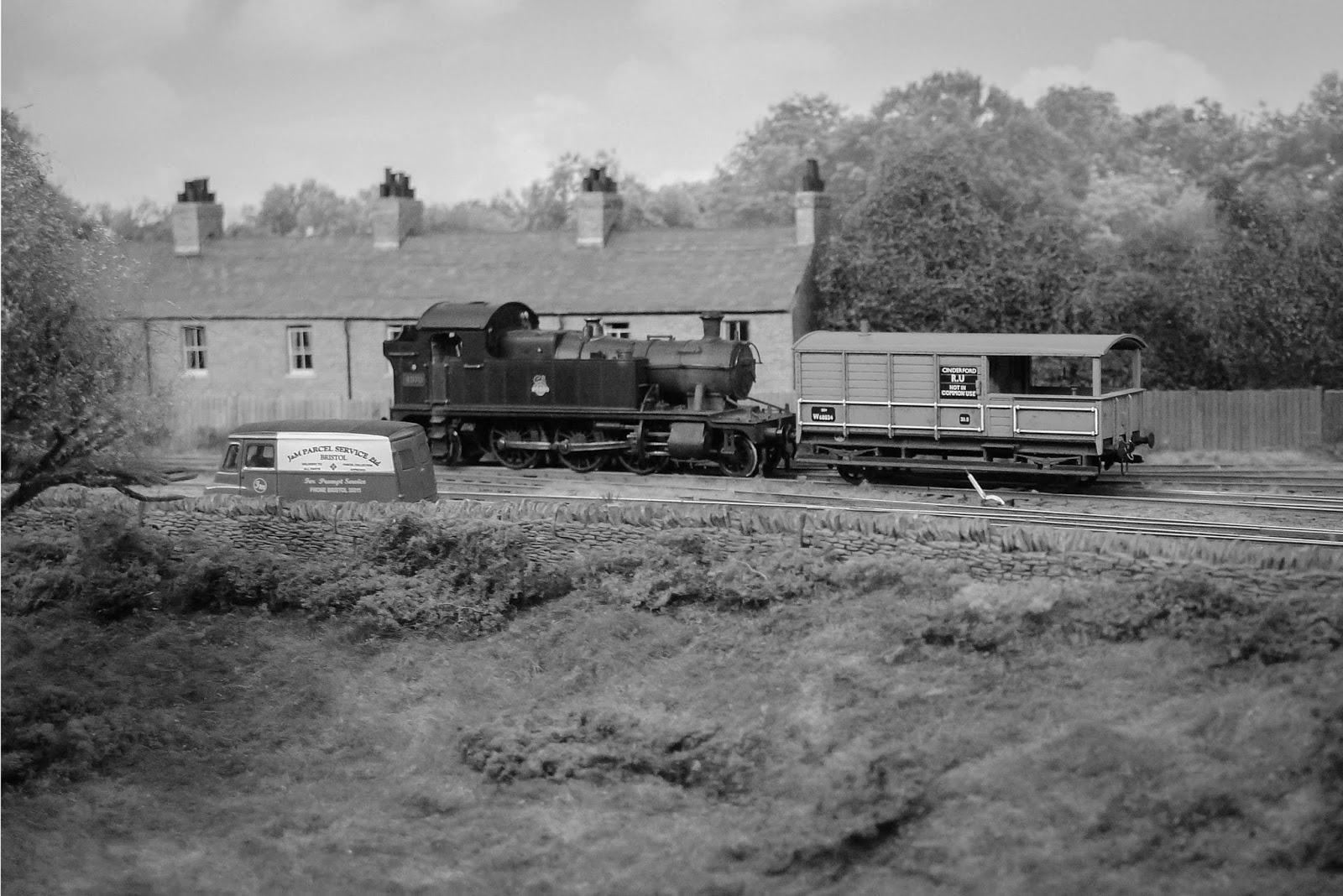


And finally perhaps my favourite shot of the day:


Sunday, 25 November 2012

Warley 2012

The Warely model railway show at the NEC has become something of an institution.  The Warley club who organise it have always built excellent layouts themselves, and from the days when I was a lad in Birmingham and  the show was held in the Harry Mitchell Recreation Centre it has attracted some stunning and memorable layouts.

I don't go every year, not least because I do find my fellow enthusiasts a rather unappealing crowd with their body odour, beer bellies, rucksacks, lack of social awareness and dubious fashion sense. Sorry, but that is how it is. In recent years I've also found the standard of the layouts more variable. I suspect in part though this is because the general standard of modelling has improved so much, and  the model railway press do such an excellent job of showing layouts in their best possible light that itmakes it hard for them to live up to expectations.

I point this out because when captioning photos on my Flickr photostream for the show I couldn't help feeling I was being very negative. On reflection I think it was because I was subjecting the layouts to the sort of scrutiny I'm giving to my own efforts and also it makes a difference viewing a layout through the lens of a camera - you become very aware of those things that destroy the illusion of reality.  Incidentally if the crowds round some of the layouts were anything to go by my view of some of the layouts wasn't shared by the majority.

So what follows is a very personal view, and isn't intended to be derogatory in any way.

Lets Do The Time Warp Again

Having mentioned how much modelling has improved in the last thirty years it is disappointing to see elements that wouldn't have looked out of place on the typical Railway of the Month from the 1960s. Topping that list has to be trees made from lichen, poor back-scenes and obvious straight line baseboard joins.

Nice wagons, shame about the trees

Sadly the one layout I really went to the show to see, Hospital Gates, suffered badly from both the baseboard joint issue and a back-scene that didn't integrate well with the modelled portion of the layout.


It was a real pity, because clearly a lot of thought had gone into the backscene, and it had been painted with considerable skill and thought. Overall this is a great layout but one that struggles to live up to published photographs of it.

Incidentally Bath Green Park was another layout which I felt  had a mismatched style of backscene despite trying to recreate a realistic sky line.I found it quite distracting on an otherwise stunning layout,

Photos v. the Real World v. Exhibition Halls

It really is a lot easier to build a layout to be convincing to the camera in individual shots than to be convincing to the human eye taking in the whole layout from an unlimited number of angles. Two of the best continental layouts on display, the well known Veldhoveh 1935 and the new to me La Baraque addressed this by careful presentation and control of the eyeline to ensure cameos attracted the attention rather than the whole layout.


Veldhoveh - almost like being there

La Baraque had a touch of the Madder Valley about it

Both these layouts take a novel approach, Veldhoveh's is very theatrical and involves forced perspective with buildings (and trams) in dufferent scales

That is what a model railway backscene should look like


La Baraque is designed to be viewed in the round, and this seemed very popular. It does lead to a few odd visual problems where the backscene doesn't extend across the whole of your line of vision.

The conclusion I walked away with is that proper framing is vitally important, and too many layouts don't take it into account. Again I could be being a little unfair because  framing might be more evident in the rooms they normally live in where they are observed from a more restricted space.. There is no doubt that a large exhibition hall like the NEC distorts things spatially. 4mm and even 7mm stock seems to shrink which means you don't get a feel for just how big some of the layouts on display are.

Another challenge of the exhibition hall is lighting. It is one of the reasons most of my photos from the show have been subjected to more post processing than I normally indulge in. You get a real mix of lighting sources that can distort colour not only in photos but to the eye as well. Most layouts at the show recognised  the importance of lighting but in counteracting the hall lighting the effect achieved was more often than not that of a Summer's day in India rather than a typical British day. The only days I saw any sunshine this year were on my trips to India.

Because my photo blog is currently based around using a compact camera for a year I used the trusty D-Lux for all these shots. The DSLR with a decent prime would have been my camera of choice. As always photographers were out in force, and as always I found myself wondering about the type of photos people were taking and what they were intending to do with them.

Cars and Boats and Planes

The standard of boats on most layouts has improved enormously over the years, and you had to be impressed by Maid of the Loch on Balloch Pier


The choice was cut off the mast or show another prematurely truncated back scene


Along with the improvement with the boats has come some staggeringly good modelling of water in different states, like this scene on Coldrennick Road.

The illusion of depth here was ruined as soon as a train was in the frame

When it comes to road transport though there is something I don't understand. The basic quality of cars and lorries available to the 4mm scale modeller in particular is everything you could ask for, yet on layout after layout they stick out like a sore thumb. Why? Sometimes it is because the model has become a bit of a cliche, sometimes it is the finish, often even attempts to improve realism seem to have the opposite effect  - especially anything involving chrome - and perhaps above anything else there is something about how they are placed on the layout. This I think can probably be divided into two elements: How they are posed to look natural, which to me means looking like they've been parked by a human driver, and secondly how they "sit" on the layout.

At the moment this is putting me off any plans to put a lorry on my layout, even though several photos I have of the Tanat Valley in the period feature them.

As for planes...well just don't, they never work.

Operation

It wasn't until I got home that it struck me that I'd hardly bothered to watch any of the layouts actually operating. I suspect that this is because operation isn't going to be a major feature of Apa, and the layouts that most caught me eye worked just as well, if not better, without a train in sight, like Bryn-y-Felin

Just add rain


For me perhaps another element is at play, that I can best sum up as "involvement" A couple of layouts were finely observed and exquisitely modelled but didn't grab me in any way emotionally. Hope Under Dinmore is a good example.


And the Winner is...

I want to stress again that I've emphasised the negatives because they are things I want to avoid myself, and that I'm aware my tastes might not be mainstream. I'm sure many would have gone for Liverpool Lime St, Bath Green Park or Hospital Gates. I've already said how good I thought Veldhoveh and La Baraque were.

If you go by the number of photos I took then the old charmer that is Charmouth was a clear winner.


When I go by the time I spent just looking at a layout though, then the winner is the one that made me think "Yes, that's what I'm trying to achieve" and on that criteria the prize goes to Allt-y-Graban Rd. This might be bad news because on that basis I might have to widen my gauge a little.


Allt-y-Graban Road. Picture perfect