Xmas seems to be rather extended this year.
An unexpected present has just arrived from Jakub at Lcut. In keeping with my hints about TAoC it is an overbridge based roughly on the ones to be found on the Fairford branch.
The first thing that struck me is just how many components are in the box considering the price. In fact I couldn't find a sheet of paper big enough to put them all on to take a photo.
I've always taken their kits to be a starting point and this one in particular gives you a fair amount of freedom in how you put it together. The downside of that is it is possible to put it together in a way that might not meet with the full approval of the Civil Engineer's department so I highly recommend making much use of photographic evidence.
Whilst a nice kit in its own right it has also made me realise how much I want to play around with their products as a scratch-building aid.
This has certainly given me the much needed impetus to push on with the replacement Apa module using my first attempt at EM gauge point building from, oh let me see, almost exactly a year ago. That in turn frees up my original Apa box for a tramway layout although the jury is still out on whether that will be in 7mm or 4mm scale.
On the subject of small suppliers I've also had excellent service this week from Alan at Quarryscapes this week, who produces 3d replacement parts for the 14XX. The more I look at photos of the real thing the more work I realise I need to do..
Showing posts with label The Art of Compromise. Show all posts
Showing posts with label The Art of Compromise. Show all posts
Tuesday, 30 December 2014

Thursday, 2 October 2014
Ready to Print
So I'm sure I've said this before but the Templot track plan for my The Art of Compromise based layout is just about ready to go.

I have to say it looks much less elegant as a plan on the page than it does when printed out full size and laid on the baseboards

There are a few things I'm less than happy about, especially when it come to sleeper spacing and the catch points , but I'm sure I can sort some of those out during the build. Somewhere I've lost a subtle curve in the foreground loop as well.
Other aspects have worked better than I expected though, especially the division of points avoiding baseboard joins and structural members.
This first iteration is going to conform very much to Roy's original conception of the design, with strong echoes of the Fairford Branch.You might want to keep an eye on the Lcut website because we've been collaborating on a few ideas. However I'm building it with one eye on eventual conversion to a pastiche of the TVR which, given the small size of the buildings, should add considerably to the deceptive spaciousness of this bijou model. I might add an extra board as well to model the engine shed and quarry spur from Llangynog.
I have to say it looks much less elegant as a plan on the page than it does when printed out full size and laid on the baseboards
There are a few things I'm less than happy about, especially when it come to sleeper spacing and the catch points , but I'm sure I can sort some of those out during the build. Somewhere I've lost a subtle curve in the foreground loop as well.
Other aspects have worked better than I expected though, especially the division of points avoiding baseboard joins and structural members.
This first iteration is going to conform very much to Roy's original conception of the design, with strong echoes of the Fairford Branch.You might want to keep an eye on the Lcut website because we've been collaborating on a few ideas. However I'm building it with one eye on eventual conversion to a pastiche of the TVR which, given the small size of the buildings, should add considerably to the deceptive spaciousness of this bijou model. I might add an extra board as well to model the engine shed and quarry spur from Llangynog.
Monday, 29 September 2014
Not the Scaleforum News
This was going to be a photo-report on my first trip to Scaleforum.
Unfortunately cumulative flight delays to and from Amsterdam meant that by Saturday there was no way I could face another day of travelling. I was beginning to feel a bit brighter on Sunday, but so was the weather which persuaded me both to clean out the garden shed and to re-visit the saga of the baseboard legs.
Fairly quickly it became apparent that what I thought was a design fault I'd built into both pairs of legs was actually a constructional fault that only affected the one pair and which was quickly rectified with a hammer and a screwdriver.
That still leaves me with the problem of adding stability to a high and narrow baseboard that needs to be assembled around existing furniture in my home office, and which can standalone without the baseboard in place. I suspect I might be on a fools errand, though I have a couple of ideas to try out still.
I also found the time to assemble the Tim Horn laser cut baseboard kit I bought with the tramway layout in mind. Not that it needed much time, it just fell together with minimal effort on my part.
Now the baseboards I've already built for the Art of Compromise are OK, but I'm beginning to think Tim's might be a better bet for long term use, if only because they are deeper and the alignment between boards is so well thought out. My tramway plan might also need a bigger board if I adopt the plan so that the trams never need to reverse, avoiding the trolley pole and the driver position being out of synch.
The reason I built my own boards in the first place is because my slight variation on the design meant the turnout to the coal staithes siding would be right over a baseboard join if I used 3ft long boards.


Unfortunately cumulative flight delays to and from Amsterdam meant that by Saturday there was no way I could face another day of travelling. I was beginning to feel a bit brighter on Sunday, but so was the weather which persuaded me both to clean out the garden shed and to re-visit the saga of the baseboard legs.
Fairly quickly it became apparent that what I thought was a design fault I'd built into both pairs of legs was actually a constructional fault that only affected the one pair and which was quickly rectified with a hammer and a screwdriver.
That still leaves me with the problem of adding stability to a high and narrow baseboard that needs to be assembled around existing furniture in my home office, and which can standalone without the baseboard in place. I suspect I might be on a fools errand, though I have a couple of ideas to try out still.
I also found the time to assemble the Tim Horn laser cut baseboard kit I bought with the tramway layout in mind. Not that it needed much time, it just fell together with minimal effort on my part.
Now the baseboards I've already built for the Art of Compromise are OK, but I'm beginning to think Tim's might be a better bet for long term use, if only because they are deeper and the alignment between boards is so well thought out. My tramway plan might also need a bigger board if I adopt the plan so that the trams never need to reverse, avoiding the trolley pole and the driver position being out of synch.
The reason I built my own boards in the first place is because my slight variation on the design meant the turnout to the coal staithes siding would be right over a baseboard join if I used 3ft long boards.
But having rethought the design I think it works best as Roy first drew the plan, which means that 3ft boards aren't an issue. The trouble is that means returning to the arcane universe of Templot to make the revisions,
The photos feature one of my Airfix 14XXs. The good news is that the Ultrascale EM gauge wheelsets for it arrived last week.
The bad news is today an email arrived from Mainly Trains to say they no longer stock the 14XX detailing pack, or the chassis to fit the GEM Cambrian 2-4-0T.
Both bits of news are a very serious blow to my plans.
Monday, 9 June 2014
Jigsaw Puzzle
Building a model railway, particularly a finescale one based, be it at best loosely, on a real location, feels a bit like doing a jigsaw puzzle with only some of the box art in front of you.
This, let me be clear, according to "18.2mm and All That" is largely a Good Thing. It is part of the fun.
I can while away happy hours in a departure lounge trying to work out how the elements will fit together. I can even while away happy hour in a lounge before departing and trying to work out where the door is.
Like doing a jigsaw puzzle often the moment a difficult piece is finally found is followed by the thought that it was so obvious you don't know why it was such a struggle to find it earlier. Answers to most questions are easier with hindsight.
However, I'm not at that stage yet, I'm still struggling to get the edges in place having hopefully correctly identified the corners.
Two things have brought this to mind. The first is assembling the 3D jigsaw that is a bullfrog manual point motor. I can't remember who first suggested I try these but I'm sure when they did there was a UK distributor. Ordering from the USA meant I ended up with both a hefty shipping charge and a £19 VAT/Royal Mail handling fee.

This is probably a good example of a product where overseas sales might best be handled as a downloadable file for laser cutting/3D printing and a parts list for the locally sourceable components.
The other is trying to finalise the timbering arrangements for Upwold in Templot. This, I suspect, could take some time, but will be worth it in the end. I think a little knowledge, garnered from David Smith's excellent book, is turning out (sorry) to be a dangerous thing. I'm just not sure where I should be interlacing sleepers and where I should be using timbering.
Hopefully this link might take you to the Templot file. Otherwise here is a screenshot.

Obviously all offers of help will be gratefully, indeed grovellingly, received.
Once I've got the timbering sorted I can think about designing the point rodding and signal cabling, and in case anyone wants to help with that the intention is the groundframe will be placed on the platform opposite the entrance to the loop.
Meanwhile if you are thinking this is just more procrastination can I just say that construction of the goods vehicles is coming along well. What isn't is my confidence level that I have the right braking arrangements for ex-GWR vehicles in the late 50's and early 60's. Yet more parts of the jigsaw.....
This, let me be clear, according to "18.2mm and All That" is largely a Good Thing. It is part of the fun.
I can while away happy hours in a departure lounge trying to work out how the elements will fit together. I can even while away happy hour in a lounge before departing and trying to work out where the door is.
Like doing a jigsaw puzzle often the moment a difficult piece is finally found is followed by the thought that it was so obvious you don't know why it was such a struggle to find it earlier. Answers to most questions are easier with hindsight.
However, I'm not at that stage yet, I'm still struggling to get the edges in place having hopefully correctly identified the corners.
Two things have brought this to mind. The first is assembling the 3D jigsaw that is a bullfrog manual point motor. I can't remember who first suggested I try these but I'm sure when they did there was a UK distributor. Ordering from the USA meant I ended up with both a hefty shipping charge and a £19 VAT/Royal Mail handling fee.
This is probably a good example of a product where overseas sales might best be handled as a downloadable file for laser cutting/3D printing and a parts list for the locally sourceable components.
The other is trying to finalise the timbering arrangements for Upwold in Templot. This, I suspect, could take some time, but will be worth it in the end. I think a little knowledge, garnered from David Smith's excellent book, is turning out (sorry) to be a dangerous thing. I'm just not sure where I should be interlacing sleepers and where I should be using timbering.
Hopefully this link might take you to the Templot file. Otherwise here is a screenshot.
Obviously all offers of help will be gratefully, indeed grovellingly, received.
Once I've got the timbering sorted I can think about designing the point rodding and signal cabling, and in case anyone wants to help with that the intention is the groundframe will be placed on the platform opposite the entrance to the loop.
Meanwhile if you are thinking this is just more procrastination can I just say that construction of the goods vehicles is coming along well. What isn't is my confidence level that I have the right braking arrangements for ex-GWR vehicles in the late 50's and early 60's. Yet more parts of the jigsaw.....
Monday, 26 May 2014
Good Enough For All Practical Purposes
Mike Cougill's excellent and thought provoking blog has been looking at the concept of the Freedom Layout again. In doing so he has referred to a formula familiar to project managers around the world that essentially boils down to "You can't have everything"
Mike explicitly talked about cost, size, quality and time as the main elements that need to be optimised if a layout is going to get built and not be a millstone around the owners neck.
From where I'm sitting on the learning curve I would have to suggest there are two other factors, and to complicate things they aren't static.
One is skill. I'm very aware that my skills have improved since returning to the small scale side of the hobby, but at the same time I'm learning new skills I'm also coming across new barriers of incompetence. I don't want to limit my modelling to what I know I can achieve today, but at the same time I don't want to be so ambitious that I reduce the chance of success.
The second is prototype knowledge.
When I set off on this journey I thought I was reasonably knowledgeable about railways. In fact if the conversation is about narrow gauge railways of the British Isles I can probably hold my own in a pub conversation.
What I didn't realise is the extent of my ignorance about certain aspects of standard gauge railways that I now think are essential for building a realistic model. Point rodding is an obvious example, but only one of many. Frankly I had no idea how the brakes really worked on wagons - and didn't need to until I started to think about how to model them.
There is, I suspect, a third factor, which is the point at which additional effort becomes of limited value in adding to the overall effect. I suspect it will be sometime before I have to worry about reaching that point.
All of which brings me back to TaOC again.
Whilst travelling and the weather have both been interfering with my modelling they haven't completely stopped me thinking about it, and the actual degree of compromise I'm prepared to accept. If I was building it in OO I think even at my usual glacial place I would have it up and running by now, but then what would be the fun in that?
Should I have gone with copperclad trackwork though? That would have speeded things up even in EM.
So would going with the track plan as it came out of Trax, but I made the call that I wanted to put the final plan together in Templot so I have more guidance when converting the template to track and so I can sort out things like conflicts between timbering and sleepers.
So that is what most of my bank holiday Monday has involved, and here is the Templot design as it currently stands. A little more tweaking is needed but it just about works.

I've tried to get it as close to Roy's original design as possible whilst still using A6 points. Ideally I would have liked to use B6. For comparison this is how my Trax version looked. At the end of the day there isn't much in it. I used A5 points in the Trax version but I don't think the space saving was worthwhile.

Mike explicitly talked about cost, size, quality and time as the main elements that need to be optimised if a layout is going to get built and not be a millstone around the owners neck.
From where I'm sitting on the learning curve I would have to suggest there are two other factors, and to complicate things they aren't static.
One is skill. I'm very aware that my skills have improved since returning to the small scale side of the hobby, but at the same time I'm learning new skills I'm also coming across new barriers of incompetence. I don't want to limit my modelling to what I know I can achieve today, but at the same time I don't want to be so ambitious that I reduce the chance of success.
The second is prototype knowledge.
When I set off on this journey I thought I was reasonably knowledgeable about railways. In fact if the conversation is about narrow gauge railways of the British Isles I can probably hold my own in a pub conversation.
What I didn't realise is the extent of my ignorance about certain aspects of standard gauge railways that I now think are essential for building a realistic model. Point rodding is an obvious example, but only one of many. Frankly I had no idea how the brakes really worked on wagons - and didn't need to until I started to think about how to model them.
There is, I suspect, a third factor, which is the point at which additional effort becomes of limited value in adding to the overall effect. I suspect it will be sometime before I have to worry about reaching that point.
All of which brings me back to TaOC again.
Whilst travelling and the weather have both been interfering with my modelling they haven't completely stopped me thinking about it, and the actual degree of compromise I'm prepared to accept. If I was building it in OO I think even at my usual glacial place I would have it up and running by now, but then what would be the fun in that?
Should I have gone with copperclad trackwork though? That would have speeded things up even in EM.
So would going with the track plan as it came out of Trax, but I made the call that I wanted to put the final plan together in Templot so I have more guidance when converting the template to track and so I can sort out things like conflicts between timbering and sleepers.
So that is what most of my bank holiday Monday has involved, and here is the Templot design as it currently stands. A little more tweaking is needed but it just about works.
I've tried to get it as close to Roy's original design as possible whilst still using A6 points. Ideally I would have liked to use B6. For comparison this is how my Trax version looked. At the end of the day there isn't much in it. I used A5 points in the Trax version but I don't think the space saving was worthwhile.
Sunday, 27 April 2014
Baseboard Blues
Building the baseboards for Upwold has felt like a long slog at times. In reality they have gone together quite quickly in terms of working hours. Most of the delay has been down to trying to find time, the constraint of never having enough clamps, and waiting for glue to dry. Oh yes, and because most of my woodwork has to take place outdoors the weather has been a factor as well.
I had some bleak moments today though.
The first was whilst trying to clamp together the base for the traverser table. It took me far longer than it should have done to realise that the clamps I were using weren't actually clamping on the right combination of parts..
I also ran into a few avoidable issues with establishing the best method of joining the baseboards in the correct alignment. In the end I've gone for a combination of techniques. I'm using some lightweight dowels and toggles from Station Road Baseboards for those times when I'm going to want to quickly join the boards together during construction, but for semi-permanent alignment I'm using C+L tee nuts That was a late decision, and to be honest once I've got the boards mounted on legs it might prove to be overkill, but I was worried by the lack of rigidity relying on the just the dowels and toggles. I would have made life easier for myself had I drilled the holes for the |bolts earlier in construction.
And then, just as I finished, I remembered that I had some removable pin hinges lying around, which is what I'd originally planned to use and would probably have been the best all round option.
And then, just as I was putting everything away, it suddenly dawned on em that I'd made no provision for cabling between the boards. Fortunately a hole cutter sorted that problem out fairly quickly.
I had some bleak moments today though.
The first was whilst trying to clamp together the base for the traverser table. It took me far longer than it should have done to realise that the clamps I were using weren't actually clamping on the right combination of parts..
I also ran into a few avoidable issues with establishing the best method of joining the baseboards in the correct alignment. In the end I've gone for a combination of techniques. I'm using some lightweight dowels and toggles from Station Road Baseboards for those times when I'm going to want to quickly join the boards together during construction, but for semi-permanent alignment I'm using C+L tee nuts That was a late decision, and to be honest once I've got the boards mounted on legs it might prove to be overkill, but I was worried by the lack of rigidity relying on the just the dowels and toggles. I would have made life easier for myself had I drilled the holes for the |bolts earlier in construction.
And then, just as I finished, I remembered that I had some removable pin hinges lying around, which is what I'd originally planned to use and would probably have been the best all round option.
And then, just as I was putting everything away, it suddenly dawned on em that I'd made no provision for cabling between the boards. Fortunately a hole cutter sorted that problem out fairly quickly.
Saturday, 28 December 2013
Playing Around in Templot

Now how did that happen?
Printed out and with the TVR goods shed placed on the plan it still seems to work, though the narrow clearance in the loop doesn't look right.

Which leads on to this iteration. The turnouts are B6 except fir the one to the goods shed that is an A5 but still gives a minimum radius of 42" that I hope will just about be acceptable for shunting with a 14XX.

My mind tells me the best approach is to flip it over so the goods yard is at the front and to place the platform on the loop, but my heart wants to keep it this way and keep to the "bitsa" station idea I used on Apa, bearing in mind in theory there shouldn't be any passenger services except the odd brakevan special.
*That is if she doesn't crash it again - a week old and it is already in the body shop.
Friday, 6 December 2013
Two Plans
 |
| Llansilin Road |
So these are the latest versions of the two plans.
First the modified version of Llanrhaiadr Mochnant based on the valuable input from Richard Ough.

Perhaps the most obvious visual change is the move of the catch point at the up end of the loop. I've also dropped any hint of the second platform.
Then the modified version of TaOC, which isn't any more, because thanks to a suggestion from Kane the plan has shifted to being based rather more on Easingwold East but still with the station at the entrance to the scenic section and the goods shed at the down end.

Of course now the penny has dropped that since building this new compact design, provisionally called Llansilin is going to take the next eighteen months to two years then by the time I get to build Llanrhaiadr I might have enough space available to build it to fit a larger space so I can revert to a more spacious and authentic version. After all the kids are bound to leave home some time, aren't they?
Monday, 2 December 2013
Compromising Design
Few classic layout designs can have been both so inspiring and frustrating as Roy Link's "The Art of Compromise" in the October 1978 Railway Modeller.
I know I keep coming back to it on this blog, and I know others do as well.
I think, from a personal perspective, it is time for me to take a critical look back at that original article
The inspiration comes from the possibility that in a 6ft by 1ft space you can build a model that is "a subtle blend of the diorama... and a working layout" that is a "moderate operational unit itself" and that "incorporat(es) details not normally found on the average model railway"
Remember this was back in '78. Lichen is king.
Roy's coloured illustration accompanying the article is itself inspirational, but so is the fact that the design could, in those days, be built using the readily available Prototype Models card kits, incorporated just about all the features of a typical branch line station except an engine shed, and had an interesting track plan that separated the loop from the platform. It is no coincidence that the same issue included an article on South Leigh station, again with a track plan illustrated by Roy. South Leigh of the few stations designed on those lines. A subtle twist Roy added was the gentle curving of the track with hardly any of it parallel to the front edge of the baseboard.
So far so good.
The frustration sets in when people realise that Roy designed the layout with that tool most of us have some where - the optimistic pencil. You know the one, it allows you to draw that turnout in to fit a ridiculously small space and connect up two pieces of track without the need to check that the tangents align. The same pencil that convinces you that because there is clearance between a lineside feature and the centreline of the the track that you've drawn then there will still be clearance when the track is actually laid.
On top of that there is a presumption on the part of the reader, though never mentioned in the article, that a layout in the RM designed to use kit built buildings is probably one also designed to be built using Peco track.
I think that is probably the first pitfall people come across. I've spent hours in the past trying to come up with a workable plan using code 75 Streamline and this is still the closest I can get.

Actually perhaps it isn't that bad. I think it needs that one curved turnout to maintain the flow of the loop. However it certainly doesn't allow as much room for scenic development as Roy drew on the plan.
Roy also suggested the model would be suitable for operation by the then new Lima 45XX as well as a Metro Tank or a 14XX. That was certainly part of the appeal when I first saw the plan, even if it took me another thirty five years to buy the 45XX.
In reality though the use of anything bigger than a 14XX is a step too far to be practical.
I suspect as well many who have been attracted to this design because it has so many elements of a "proper" branch line terminus have been tempted to push the plan a bit too far themselves by adding other features like an engine shed or a proper signal box. They then either decide it can't be done, or expand the design to fit in a larger space.
Reading the article from today's perspective it is also interesting to see that the suggested baseboard construction was extremely traditional, including a Sundeala top.
So if the design is only marginally feasible in OO why am I still pursuing it as an option for an EM gauge layout?
Well first of all the 6ft by 1ft size has a very specific value in that it means it could fit across the length of my desk in the study. That also means I could work on the layout in decent light. The possibility of using several small lightweight baseboards also means I'm going to be able to turn them around and over to get at things. Apa Valley has already taught me how important and useful that is at this stage of my learning curve.
Modelling the Tanat Valley brings another key advantage. The station buildings on the TVR were all quite compact, and the goods sheds road loading bay is at the end not the side, so you don't need to allow for as much space alongside the goods shed. That alone possibly saves a couple of inches of width.
There is the small issue that this isn't a track plan the TVR would have used, but it does contain elements lifted from individual stations. For instance the combination of the overbridge, platform, signal box and start of the loop is pure Blodwell Junction
As for the use of EM, well, we've already established that this is a track plan that needs hand built track, and I think, using Trax, that it just about works.

The observant will already have spotted that this involves exactly the same amount of track building as Llanrhaiadr Mochnant, whilst probably demanding a higher degree of accuracy. My other concern is that building small areas of scenery is actually more challenging than building relatively large ones. There is still scope to ease some of the curves, though the way Trax draws things on screen paradoxically seems to make things less smooth the further you zoom out. However the final decision to build will depend on a detailed design in Templot.
I know I keep coming back to it on this blog, and I know others do as well.
I think, from a personal perspective, it is time for me to take a critical look back at that original article
The inspiration comes from the possibility that in a 6ft by 1ft space you can build a model that is "a subtle blend of the diorama... and a working layout" that is a "moderate operational unit itself" and that "incorporat(es) details not normally found on the average model railway"
Remember this was back in '78. Lichen is king.
Roy's coloured illustration accompanying the article is itself inspirational, but so is the fact that the design could, in those days, be built using the readily available Prototype Models card kits, incorporated just about all the features of a typical branch line station except an engine shed, and had an interesting track plan that separated the loop from the platform. It is no coincidence that the same issue included an article on South Leigh station, again with a track plan illustrated by Roy. South Leigh of the few stations designed on those lines. A subtle twist Roy added was the gentle curving of the track with hardly any of it parallel to the front edge of the baseboard.
So far so good.
The frustration sets in when people realise that Roy designed the layout with that tool most of us have some where - the optimistic pencil. You know the one, it allows you to draw that turnout in to fit a ridiculously small space and connect up two pieces of track without the need to check that the tangents align. The same pencil that convinces you that because there is clearance between a lineside feature and the centreline of the the track that you've drawn then there will still be clearance when the track is actually laid.
On top of that there is a presumption on the part of the reader, though never mentioned in the article, that a layout in the RM designed to use kit built buildings is probably one also designed to be built using Peco track.
I think that is probably the first pitfall people come across. I've spent hours in the past trying to come up with a workable plan using code 75 Streamline and this is still the closest I can get.

Actually perhaps it isn't that bad. I think it needs that one curved turnout to maintain the flow of the loop. However it certainly doesn't allow as much room for scenic development as Roy drew on the plan.
Roy also suggested the model would be suitable for operation by the then new Lima 45XX as well as a Metro Tank or a 14XX. That was certainly part of the appeal when I first saw the plan, even if it took me another thirty five years to buy the 45XX.
In reality though the use of anything bigger than a 14XX is a step too far to be practical.
I suspect as well many who have been attracted to this design because it has so many elements of a "proper" branch line terminus have been tempted to push the plan a bit too far themselves by adding other features like an engine shed or a proper signal box. They then either decide it can't be done, or expand the design to fit in a larger space.
Reading the article from today's perspective it is also interesting to see that the suggested baseboard construction was extremely traditional, including a Sundeala top.
So if the design is only marginally feasible in OO why am I still pursuing it as an option for an EM gauge layout?
Well first of all the 6ft by 1ft size has a very specific value in that it means it could fit across the length of my desk in the study. That also means I could work on the layout in decent light. The possibility of using several small lightweight baseboards also means I'm going to be able to turn them around and over to get at things. Apa Valley has already taught me how important and useful that is at this stage of my learning curve.
Modelling the Tanat Valley brings another key advantage. The station buildings on the TVR were all quite compact, and the goods sheds road loading bay is at the end not the side, so you don't need to allow for as much space alongside the goods shed. That alone possibly saves a couple of inches of width.
There is the small issue that this isn't a track plan the TVR would have used, but it does contain elements lifted from individual stations. For instance the combination of the overbridge, platform, signal box and start of the loop is pure Blodwell Junction
As for the use of EM, well, we've already established that this is a track plan that needs hand built track, and I think, using Trax, that it just about works.

The observant will already have spotted that this involves exactly the same amount of track building as Llanrhaiadr Mochnant, whilst probably demanding a higher degree of accuracy. My other concern is that building small areas of scenery is actually more challenging than building relatively large ones. There is still scope to ease some of the curves, though the way Trax draws things on screen paradoxically seems to make things less smooth the further you zoom out. However the final decision to build will depend on a detailed design in Templot.
Saturday, 30 November 2013
The Cost of Compromise
I'm sat here enjoying one of those lovely late autumn, early winter days where the light is just right to take the camera out for a bike ride. Or, to sit down and make a serious start on the scary art of track laying.
It is is so so tempting to get the camera and bike out, but since my darling wife has gone out shopping for today perhaps it is time to take the soldering iron by the bit (I've done that a few times in the past) and get practical.
So I have done, though it being around fifteen years since I last built any track, and thirty since I last dabbled in EM, I'd forgotten how much preparatory work I had to do. Which is why I find time now to pause and reflect whilst the sleepers are steeping in point stain solution.
In a reply to a comment from Geoff I mentioned that I was struggling with the geometry of Llanrhaiadr Mochnant. A late night yesterday has seen some real progress made on that front. I'm still not sure how to reconcile all the photos but I've worked out some of the subtle curvature involved although at the cost of increasing the baseboard width to two foot.
The apparently simple modification of swapping the in use platform from being on the down line to being on the up line of the loop has had an awful lot of knock on effects including the need to presume some alterations to the geography and history of the line. I'll share more on that when I post the next version of the track plan.
In the meantime I've started laying some track on the hastily constructed test baseboard. I'll spare you the photos for now, but being unable to resist the urge to place some OO gauge stock and the buildings from Apa on to it to see how it looks has made it rather obvious that I've subconsciously built the first couple of feet of "The Art of Compromise"
At this stage we need to add another compromise into the mix, which is our new car. Somehow I've been persuaded that after a few years of running around in a comparatively spacious Merc A class that we should buy another Toyota IQ before they go out of production at the end of the year. As the non-driver in the family I feel a little railroaded into this, but there you have it. Anyone familiar with the IQ will recognise that one description that can't be applied to the luggage space is "spacious". Not that that should matter, of course, because in theory the layout doesn't need to be portable.
If I did go down the route of building TAOC it would still be an intermediate step to LM. Llansilin Road would be the obvious Tanat Valley station to adopt to suit with a few elements of Blodwell Junction thrown into the mix.
Lets see how the track building progresses this week.
Thursday, 8 August 2013
Quiet Before the Storm
I'm sat here at eleven PM in my home office, having just about finished work for the day. The windows are wide open and I can feel a storm coming. I can also feel a storm of modelling activity approaching. My darling wife is away for the next week which is a good time to arrange for a few parcels to arrive. In fact one already has, from C+L Finescale, but I'm not opening it just yet.
The combined contents of all the boxes heading my way should be more than enough to kick start my adventures in EM. The one thing I've forgotten to order in time is a set of wheels for the Sentinel from Ultrascale.
In a way this EM gauge goodness actually gives me a fresh impetus to finish the Apa project, and if the weather holds out I'm hoping that by Sunday it will at least appear finished.
So what is in the boxes? Hopefully the makings of a couple of 4'x2' baseboards for a start, some basics to get me practicing track laying, and a Mainly Trains replacement chassis for the Ratio 4 wheel coach.. Plus a couple of structure kits for a cattle dock and a water tower which are called for by the new layout and which don't seem worth scratch building.
So if I'm about to start building baseboards do I have a final trackplan in mind?
Well yes, well two actually. Yesterday's ruminations about combining the real track plan from Llanrhaiadar Mochant, and two of my other favourite plans, Llanastr and The Art of Compromise have led to two options.
The first is the small space version, though that small space has now extended to 8' by 2' in total, including a sector table/traverser.
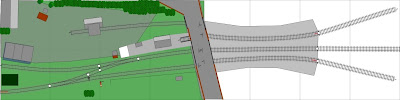
The second is 12' by 2' including the sector plate, and takes less liberties with Llanrhaiadr.

You might note that the first 4' of both plans look very similar. In fact the differences are down to some evolving thinking and the idea is to begin with the first plan and then extend it by inserting a middle board. A few things would need adjusting, notably the positioning of the weighbridge and the ground frame. The first wouldn't really be a problem, the second would because it would mean rerouting the point rodding. I might take the easy way out and leave the ground frame off stage for the first iteration.
One consequence of using the first plan is that operation could be a little odd, or interesting, depending on your point of view. Imagine a passenger train pulling in. By this stage in its history Llanrhaiadr had become the terminus of the Tanat Valley, and only the old up platform was in use. Given the limited space probably just the one bogie coach would be in view. So the loco uncouples and runs up to the water tower, then runs round back out of sight under the bridge....ah and you see now it doesn't matter whether that is the engine which couples back on to the train or not, because it is out of sight, which frees the original train loco to do something else.
The combined contents of all the boxes heading my way should be more than enough to kick start my adventures in EM. The one thing I've forgotten to order in time is a set of wheels for the Sentinel from Ultrascale.
In a way this EM gauge goodness actually gives me a fresh impetus to finish the Apa project, and if the weather holds out I'm hoping that by Sunday it will at least appear finished.
So what is in the boxes? Hopefully the makings of a couple of 4'x2' baseboards for a start, some basics to get me practicing track laying, and a Mainly Trains replacement chassis for the Ratio 4 wheel coach.. Plus a couple of structure kits for a cattle dock and a water tower which are called for by the new layout and which don't seem worth scratch building.
So if I'm about to start building baseboards do I have a final trackplan in mind?
Well yes, well two actually. Yesterday's ruminations about combining the real track plan from Llanrhaiadar Mochant, and two of my other favourite plans, Llanastr and The Art of Compromise have led to two options.
The first is the small space version, though that small space has now extended to 8' by 2' in total, including a sector table/traverser.

The second is 12' by 2' including the sector plate, and takes less liberties with Llanrhaiadr.

You might note that the first 4' of both plans look very similar. In fact the differences are down to some evolving thinking and the idea is to begin with the first plan and then extend it by inserting a middle board. A few things would need adjusting, notably the positioning of the weighbridge and the ground frame. The first wouldn't really be a problem, the second would because it would mean rerouting the point rodding. I might take the easy way out and leave the ground frame off stage for the first iteration.
One consequence of using the first plan is that operation could be a little odd, or interesting, depending on your point of view. Imagine a passenger train pulling in. By this stage in its history Llanrhaiadr had become the terminus of the Tanat Valley, and only the old up platform was in use. Given the limited space probably just the one bogie coach would be in view. So the loco uncouples and runs up to the water tower, then runs round back out of sight under the bridge....ah and you see now it doesn't matter whether that is the engine which couples back on to the train or not, because it is out of sight, which frees the original train loco to do something else.
Tuesday, 6 August 2013
Planning
As you might be able to tell my thoughts are now very much about the next layout, with the end very much in sight for this test piece. By the end of next week I'm hoping to have the bulk of the vegetation in place, and the platform in an overgrown state. That then leaves the signal box to be built as and when.
Meanwhile I've joined the EMGS - or strictly speaking rejoined it since I was a member in my late teens - and ordered a few things to get me started. Nothing too serious, but it does feel a bit chicken and eggish trying to work out the best way to start without incurring a massive expense.
It is half tempting as a test piece to build another version of this layout, but to be honest I think moving up to EM will take up just a little too much space to successfully fit the same layout in an APA box. However I could fit it on to a bigger baseboard.
The best idea will be to build something that can eventually be incorporated into Llanrhaiadr, but to be honest I suspect the learning curve is going to be pretty steep and the chances of wanting to keep my first efforts are pretty slim.
And then, once again, there is The Art of Compromise which I've already blogged about once. Yet what I failed to pick upon at that time is the the track plan for Llanrhaiadr is essentially the same as that of The AoC,but with the station moved to be on the loop. Of course the interesting thing about TAOC is that the station wasn't on the loop.
Somewhere between the two is perhaps where the swee-tspot lies, with a bit of Llanastr thrown into the mix
Meanwhile I've joined the EMGS - or strictly speaking rejoined it since I was a member in my late teens - and ordered a few things to get me started. Nothing too serious, but it does feel a bit chicken and eggish trying to work out the best way to start without incurring a massive expense.
It is half tempting as a test piece to build another version of this layout, but to be honest I think moving up to EM will take up just a little too much space to successfully fit the same layout in an APA box. However I could fit it on to a bigger baseboard.
The best idea will be to build something that can eventually be incorporated into Llanrhaiadr, but to be honest I suspect the learning curve is going to be pretty steep and the chances of wanting to keep my first efforts are pretty slim.
And then, once again, there is The Art of Compromise which I've already blogged about once. Yet what I failed to pick upon at that time is the the track plan for Llanrhaiadr is essentially the same as that of The AoC,but with the station moved to be on the loop. Of course the interesting thing about TAOC is that the station wasn't on the loop.
 |
| Llanrhaiadr 8'x2' |
 |
| Llanrhaiadr Mawr 6' x1.5' |
Tuesday, 28 May 2013
Getting Carried Away
"So" said the step-daughter "is that it or are you going to do something else?"
Given my rate of progress it is jumping the gun to be thinking about the next project, but I have been giving it some consideration.
The easy route to take is simply to build a new EM gauge version of this model, embracing all the lessons learnt to date, reusing anything I think is of sufficient quality, and pushing the envelope slightly out of my comfort zone. It would allow a before and after comparison to be made, after which the before would be consigned to the bin. But what if I were to consider a layout, rather than a diorama/shunting plank?
New Radnor is one obvious choice, not least because the line is relatively local to my old home in Herefordshire. Then there is Blodwell Junction itself,rather than my truncated version, or the terminus of the Tanat Valley at Llangynog.
Like many of my generation of railway modelers there is also the attraction of Roy Link's "Art of Compromise" design.
Where I think I'm actually heading is towards Llanrhaiadr Mochnant, which became the terminus of the line after the closure of Llangynog. I think a design based on this period would have potential.
Actually the trackplan itself is very close to that of Llangynog when it was first opened, which is useful because Lloyd's book includes the original signal diagram.
Given my rate of progress it is jumping the gun to be thinking about the next project, but I have been giving it some consideration.
The easy route to take is simply to build a new EM gauge version of this model, embracing all the lessons learnt to date, reusing anything I think is of sufficient quality, and pushing the envelope slightly out of my comfort zone. It would allow a before and after comparison to be made, after which the before would be consigned to the bin. But what if I were to consider a layout, rather than a diorama/shunting plank?
New Radnor is one obvious choice, not least because the line is relatively local to my old home in Herefordshire. Then there is Blodwell Junction itself,rather than my truncated version, or the terminus of the Tanat Valley at Llangynog.
Like many of my generation of railway modelers there is also the attraction of Roy Link's "Art of Compromise" design.
Where I think I'm actually heading is towards Llanrhaiadr Mochnant, which became the terminus of the line after the closure of Llangynog. I think a design based on this period would have potential.
|
| Plan created in AnyRail 4 |
Subscribe to:
Posts (Atom)