Moving from an OO gauge micro-layout to an EM gauge compromise, via a rather major diversion into both 7 1/4" gauge and minimal space OO9
Labels
Friday, 5 February 2016
Cadeby
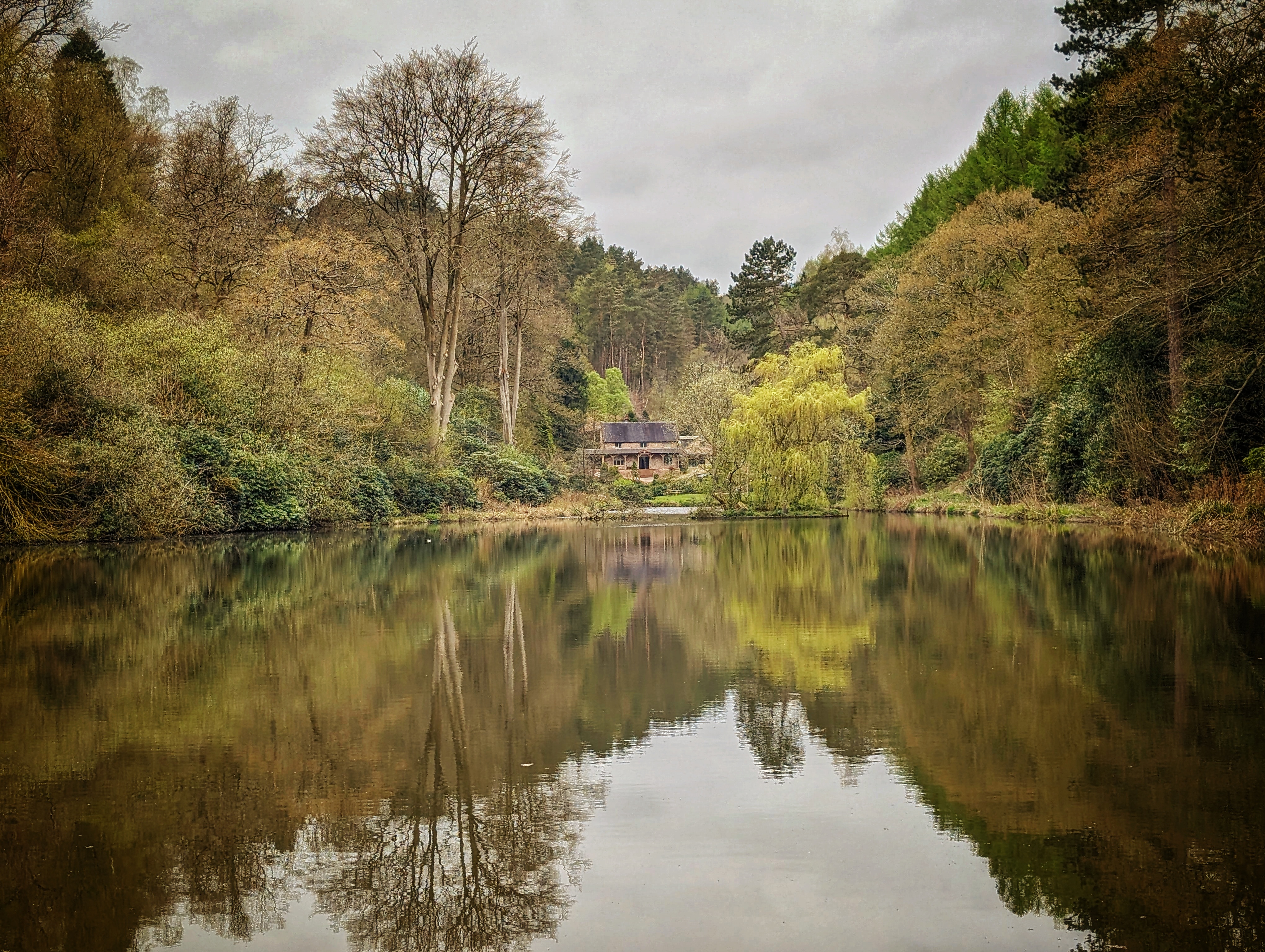
As a micro layout it has a number of advantages, not the least of which is that in some ways it was a full size terminus to fiddle yard layout, with trains disappearing into the scenic break of the woods, and then coming straight back again.It was also both short and compact.
There is a downside. Teddy's guide to the line was Rails Round the Rectory, which brings to mind an image of an old fashioned Georgian rectory and a railway running around a well tended garden, Like Adrian Shooter's Beeches line.
Teddy himself, of course, was the epitome of an English rector in the shires.
Sadly though the original rectory at Cadeby, now known as the Grange, was not the one Teddy lived in, but the more modern one
It isn't the most attractive house. So the dilemma is do I leave out the rectory altogether, or do I replace it with something more attractive.
Saturday, 28 March 2020
The Cadeby Conundrum
![]() |
| In happier days - now lacking a chimney and the cab backsheet is cracked |
Work on them and the Cadeby based micro layout came to an end when I lost my old office. I have to say that storage and the move to the studio have not been kind to them. It is quite depressing contemplating repair work before finishing them. I might even be tempted to start again on some of the cheaper 3D bodies. Other than that I will progress the models as and when, a major factor beign the suitability of the weather for spray painting. As for the layout itself, well that has now found a home in a storage box. I suspect it will see a little more use as a test track and for photography, before been denuded of trees as I borrow them for other projects.
Like Apa Valley before it, it has served its purpose. It got me back into OO9 and relatively up to date on improvements in the trade. It was always intended to be the precursor to a larger version of Cadeby that would allow for more sidings and a greater sense of place. It won't be an exact model because I'm inclined to allow for a continuous run and disinclined to model the monstrosity of a "modern" rectory.
The conundrum arises over baseboards. I've got an unbuilt Tim Horn baseboard that I originally had in mind. I've also got two other ideas that could make equally good use of it though. What hadn't really dawned on me until moving it the other day is that it isn't going to be a lightweight structure, even before I build a layout on it. That means whatever I use it for is going to need a semi-permanent home, and I'm not sure OO9 is the best use of that space.
So what are the alternatives? I'll take a look at a few more commercial alternatives, but I have a feeling I might end up using foamboard. I also think I'm going to play around with some dimensions once I've built a suitable Old Rectory and some larger trees.
Friday, 8 May 2026
Cadeby Reborn
I have previous form for finding baseboards that I'd forgotten about, and the reason why I bought them.
This week, we are having various disasters with the plumbing in the house. All of the expensive kind .
The silver lining is I had to access the furthest corner of my office - where I found a Tim Horn kit for a 2ft by 18" photo plank, still in its packaging.
I suspect I bought it back at the cottage ready to build the next version of my Cadeby-based, layout. It seemed a timely discovery, given that I'd just bought the Hornby wooden barracks block. And James Hilton produced a great build of a Fourdees Bagnall kit
Whilst on mute in a particularly boring ISO meeting, I began to explore a way forward.
It is not as straightforward as I thought.
The extra space is useful, but is it enough?
My original plan was to change from an end-to-end layout with an automated shuttle module to a continuous run. On top of which, I wanted to have a building to sit where what was then the new Rectory, without being quite as ugly.
I'm not sure that is feasible. The barracks building is surprisingly large.
I could, I suppose, build a pastiche of the layout room, about two-thirds of the size, and use the Hornby one on a pure photo plank.
The only way I believe I can fit a continuous run is to use a relatively extreme radius for the fictional section. Does that matter if the motive power is all going to be small 0-4-0s or the little Simplex and Ruston?
The Rectory will have to go. The downside is that it would have made a good scenic disguise for how short the track is. Could I replace it with something? Even just a line of preserved road vehicles?
The original micro was designed from the outset to be viewable from any side. The Tim Horn baseboard is only viewable from the front. Should I put the platform and the stock sidings at the front, or the back?
I thought it was obvious to put them at the front, so even if nothing was moving, people could see the stock. But I'm having second thoughts. It isn't how visitors could see the line, and the wooden fence separating it from the New Rectory was part of so many photos of the railway.
And one of my favourite views of the layout was standing on the road outside, watching , very briefly, a train, glimpsed through the trees. I think I'm persuading myself to go in that direction.
The last issue is The Dell, where Sgt. Murphy rested, and I used to play on his footplate.
![]() |
| You'll have to imagine the intervening trees, they don't fit in its current bookshelf niche |
Well, that and my actual plan for this weekend was sketching out a TT120 IoW Central layout based on Wootton Station, that I could call The Wight Lines.
Monday, 6 April 2026
Astrid: Murder in Paris
Some of you will know where I'm going with this. If not, bear with me and I promise the title will, hopefully, make sense well before the end of the blog.
Easter weekend has been quiet here, allowing me to crack on with revision for the five exams I've got coming up. When I was a lecturer, I had a reputation for getting students through their exams, but I've never been good, myself, at revising using conventional techniques. What works for me is something more akin to how I rehearse my conference speeches. I can't remember things by rote; I need to build a story that lets me reconstruct things in context by pulling them from my unconscious mind. The downside is that I never managed to learn the alphabet from A-Z or multiplication tables. The upside is that when I learn something, it is by applying it in the real world in the context of other things I know.
One day, I'll accept that. In the same way that I need to accept that my modelling projects often follow the same pattern. The long, fallow periods when I'm not actually modelling and feel guilty about being the archetypal Armchair Modeller are more productive than they appear, both to others and to me.
Collecting and hoarding ideas and bits and pieces without doing anything with them hides another process that even I'm not party to.
This struck me this morning, reading an article about procrastination as a creative process.
One thing my wife and I have found time to do over Easter, is to start watching Astrid: Murder in Paris on Channel 4. This is actually a Franco-Belgium detective show, originally called Astrid et Raphaƫlle. You might have seen Patience, the British remake of it.
Essentially, it is the story of how a detective,with undiagnosed AuADHD, though that is not made explicit, and an autistic archivist work together to solve puzzling crimes. Personally, I think the original is better than the remake, which is, itself, very good. The reason I think it is better is that it makes Astrid's lived experience more central to how she solves issues. That lived experience is also a lot more painful and overwhelming. At times, it isn't easy to watch, especially if it resonates with you.
One thing Astrid does is to physically make a pictorial collage of archive material on the floor of a room, that to others might look like a complete mess. And it can even look like a confusing and overwhelming mess to her until something happens that provides a catalyst for the underlying meaning she has unconsciously been exploring by mapping it, making it crystal clear. She can also hyper-focus on something that to others seems irrelevant, and sometimes is, in the short term, but not in the long term.
Whilst I was diagnosed as dyspraxic as a child, I know many around me suspect I also have some ADHD characteristics. That isn't surprising, because we know neural diversity has several dimensions. Perhaps that is why the interactions between the two characters makes so much sense to me.
From a modelling perspective, it means my sudden bursts of creativity and action are often preceded by long periods of chaos and procrastination, along with shifts in focus.
Take the Cadeby based projects.
The recent Apedale event reminded me that it is now forty years ago that Teddy died. Meanwhile, my original, quickly built, Cadeby micro has been sat on a shelf since the house move, unused and with the stock in a box somewhere in the attic. My thinking since the move has been taken up with the future of my 7 1/4" assets and the N gauge projects.
At least, my conscious thinking has been.
But the micro has always been there, denuded of trees to fit in a space it wasn't built to fill.
It might have been very simple, built on a free baseboard from Tim Horn, and designed to work using a shuttle module, with a non-functional turnout leading to a siding to display locos. But I'm emotionally attached to it. There has always been one downside to it, To fit the small baseboard, I scratchbuilt a pastiche of the ex-army prefab that housed Teddy's 4mm layout. It was a quick build, using Redutex woodsiding, partly as an experiment to see how it worked. In my own eyes, it didn't, with massive gaps between planks and proving hard to get sharp corners.
I bought a resin replacement from a wargame supplier, but then Hornby brought out their version, which was a lot better, but at a stupidly high price point.
Earlier this week, I found it for sale at an equally ridiculous discount.
So I'm now back to considering ideas for the long-shelved (groan) bigger version of the micro. There are a couple of key design issues. One is that Iwant to use the Peco OO9 starter trackset, the other is that I need somewhere to put it. That is a real challenge because of the width. This is the only idea I have, but a shelf layout above a door, only viewable from halfway up the loft ladder, is hardly ideal.
Finally, a reminder that this weekend is the Macclesfield show.
I'm planning to go on the Saturday morning. There are some great layouts booked, but...
The big "but" for me is their published policy about photography and SocMed over the weekend.
Like many recent shows, they are applying a blanket embargo on photos from the show until it is over. An embargo I intend to comply with.
The argument, which makes sense on paper, is that people won't bother to go if they've already seen photos.
But my experience is the opposite. If I see photos that make the show look better than I expected, then I am more likely to make the effort to go in person. Either the next day, or next year.
They are also claiming ownership of the copyright for all images taken at the show. I don't think that would stand up in court. It isn't on public property, which has some bearing, but it isn't their property. The National Trust, for example, recognises that it does not own the copyright of images taken on its properties, but does, legitimately, own the rights to the commercial use of images.
That makes sense, I have heard of issues from other shows about 'Influencers' causing issues by making long videos that have been intrusive on exhibitors, traders and visitors, but I haven't seen that myself. I do see how that could be a problem.
I've no doubt this will be a great show, perhaps with a few teething issues from being at a new venue, but what if it wasn't? What if people went on day one and realised a show was a rip-off? Outside of the model railway world, thankfully, we can all think of examples of that.
For my own part, I've always tried to give shows reviews that are positive but fair. I felt bad posting some of my views on the Manchester show, but I still felt it was reasonable to say that there were two, quite large, layouts, where I didn't see a single train move.
Anyway, for what it is worth, before I get banned from the exhibition for life, here is my review of last year's show. The list of this year's layouts looks even mouth-watering.
Wednesday, 12 September 2018
Seeing the Wood for the Trees
Rails Round the Rectory might be a micro layout, but it still required seven trees to form both the wooded end of the layout and to balance that out visually at the graveyard end. In the past, the few trees I've made have been knarled and sparse Welsh hillside ones. An overgrown rectory garden calls for quite a different look.
Somewhere I have a detailed plan of the trees in the garden at Cadeby, for use if I ever build the larger version. On RRtR I decided generic Woodland Scenic armatures would suffice, with differences in leave and branch materials to give a sense of variation. This sped up construction considerably.
The slow bit comes with the post-construction trimming. I haven't started that on this one so it looks rather too dense and has those telltale horsehair loops. The loops need two cuts, to remove part of the material otherwise they still look like loops. Apart from removing the majority of the straggling branches the other main trim is to cut in horizontally to give a more layered effect.
I've never managed to finish counting the trees in our current garden. In places, they are as overgrown as the ones at Cadeby were. In reality, that means there is much less space between them than you would expect, and very few of them have a clear shape. I did think about trying to replicate that, but the catch would be losing some of the possible viewpoints on the layout. I might yet fill in some of the below canopy gaps with substantial shrubs once I've discovered what does and doesn't work as a cameo view.
I've been struggling to get decent photos of the layout at this stage in its construction. It really needs outdoor lighting
![]() |
| Trying out possible combinations of trees. Looking back at this I realise I made an eighth tree that I seem to have lost somewhere |
Tuesday, 4 February 2025
Buffer Stops
I must stop being so hard on myself about procrastinating.
Some of it is down to my neuro-diversity, but often, there are actually good underlying reasons for it.
I've not got much real modelling done since I came to a full stop on Flemish Quay nearly three years ago, for the reasons I mentioned at the time.
It is a shame because I liked its composition and simplicity.
Flemish Quay is an example. I should have scrapped the warehouse and started again once I realised I'd miscalulated the clearances for the door. In fact, had I got a supply of Busch track, I would start from scratch, with the same plan but with refinements here and there to take into account the things that didn't quite work or were always experiments. But I did love the basic idea and composition.
As it is, it is sitting forlornly on the very highest display unit in my office, gathering dust.
.
Not only that, but the remaining construction items, including the parts needed to build a new warehouse, the missing lifting bridge, and all the stock, are filling up quite a remarkable number of storage boxes for such a small project. And so are all my other small projects. Even the Cadeby-based micro, which I'll come back to later.
It is only a year after moving and three years after we started packing, ready to move, that I've had a chance to sort through my modelling boxes. It isn't easy because a lot are in the loft space, which is absolutely full of a mixture of model supplies, photographic gear, my business book library, and Issy's seasonal decorations. And hidden at the back, everything I need to build TAoC once I can free up the space to get to it.
With my mother away for a few weeks, I've taken the chance to reorganise my office/studio to make modelling easier. Just a bit of 3D Tetris has created the ideal space for my Hobby Zone units. That has made a huge difference. Having most of my tools back in easy reach in one place makes it so much easier to just get on and do things. Especially those tiny little jobs that tend to build up in a backlog. I've got lots of little soldering jobs to do, none of which would justify getting an iron out by themself.
That gives me a couple of months to focus on indoor projects. As well as Gerralt Rd, I'm going to think about restoring/rebuilding Flemish Quay and the Cadeby pastiche. Whilst I've got the scenic stuff, like tree armatures and static grass, on the worktop, I might as well start on a Mosslanda photo plank, and I seem to have accidentally acquired everything I need for a Titchfield diorama.
As for Gerralt Rd, I'm still not 100% sold on the final composition, but I'm currently working on the Penybontfawr station building, having revised my approach to it. I suspect I will still need a couple of attempts before I'm happy.
This brings me to the buffer stops. Subconsciously, the question of buffer stops has been one reason for my lack of progress. It makes sense when I think about it. I learned on Apa that it is hard to retrofit detail once the track is painted, ballasted and landscaped. The bufferstops need to be seamlessly integrated with the scene, and there are three of them in a key visual position. The problem is, all the commercial N gauge products are unbelievably crude in comparison to the Finetrax track.
Of course, as a member, I know about the 2mm society GWR bufferstop kit, but, stupidly, I didn't look at them because I presumed they would be specific to 9,42mm gauge. Of course, they aren't...
Friday, 24 October 2025
A Tidy Office..
...is the sign of a broken computer.
At least that is what the sign Issy bought me many years ago says.
Strictly speaking, it wasn't the computer that broke. The pole supporting the telephone and power lines to the house had to be replaced yesterday. The guys who did it were incredibly quick and also very helpful, ensuring we could still get the car in and out.
Whilst we had no power, I made a start on reorganising my office studio again. For once, the dogs were a great help—they were locked in the kitchen to avoid me tripping over them.
As well as tidying a few things up, I've changed which side I sit at my main modelling desk, and moved my tool storage units onto it. Part of the reason is so my modelling isn't visible when I'm on video calls, but I also like having tools close to hand. It should also reduce how often I trip over the dogs, and give me room to display the latest idea for the East Coast-based 4mm micro.
One thing I'm not sure about is the lighting, but we will see.
Also on the bookcase are my two 16mm Fowlers.
Finally, on the model front, I've been trying to improve both the sea and the tree on one of my Kato modules.
Perhaps I could save myself a lot of effort by modelling a scene like this, on one of our regular dog walks.
The truth, after all this, is that what is driving my activity isn't the broken computer. It is feeling miserable as hell with late-paying freelance clients, frustrating systems for freeing funds from my investments, and being constantly turned down for full-time gigs whilst being in demand as an "Industry Expert"
Saturday, 31 March 2018
Rails Round The Rectory
I'm a big fan of both the Petite Properties kits and the Redutex self-adhesive textures sheets. In fact, I've had some of both in store for a long time so I decided it was time to actually do some modelling.
I still haven't got the hang of getting the quite thick Redutex to go round corners. I've also been experimenting with a combination of "watercolour pens" from Arteza and gouache colours to build up texture.
Talking of texture, having finally got hold of a Gorden Gravett's book on modelling broadleaf leaves I thought I would have another go at trees, since they were a big feature of the garden at Cadeby. This was really nothing more than a 3D doodle, made from twisted wire, acrylic gesso, and artificial hair. Still a work in progress, but it is amazing how many deficiencies a photo reveals.
Having said which I still think it is better than my attempt at a tree on Apa Valley using a commercial armature and rubberised horsehair., despite the best efforts of my workshop assistant to get in the way.
Incidentally, that is a Tim Horn display stand on view, the start of the shed containing Teddy's 4mm layout and a corner of the baseboard.
A story for another day is about how I very nearly made a very silly mistake with the wiring....
Tuesday, 23 March 2021
On The Surface
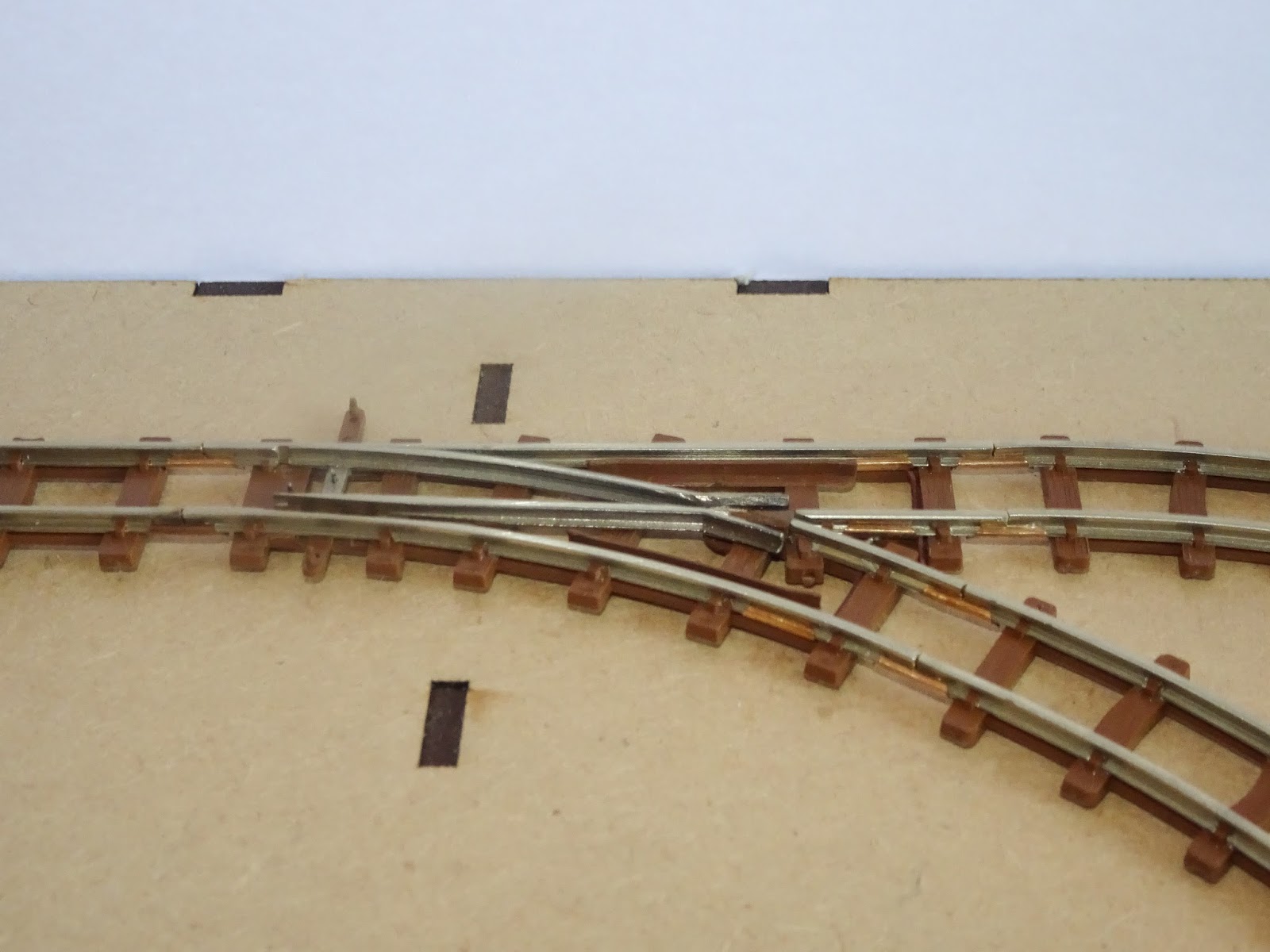
I've never been happy with my various attempts at manual point control. They have worked, but always felt a bit Heath Robinson. When work on TAoC recommences I'll probably use Blue "manual" turnout motors. Some would quibble about the cost but I want something that will be as foolproof and reliable as possible. Having said that I could even use the Morgan Design TOUs again.
![]() |
| Bodging the point control on Apa Valley. How hard would it be for someone to produce this as a commercial product? So many of us have done it. |
Back to Grundy's Yard, I want something foolproof and reliable. I'm using Mercontrol to operate the points, the question is where to place the microswitches, and what type to use. Where to place them depends on whether I value accessibility more than reliability. The type depends on the location
What would make life very easy would be if the Peco undertrack microswitch could be attached directly to a turnout, rather than to the point motor, and had arms to attach an operating wire to. I'm wondering if I could adapt them in that way, possibly in conjunction with the adaptor base. I'm also hoping that the tolerance that seems to be built into Peco's products designed for use with their somewhat brutal point motors might avoid the need for omega loops, which would be one less thing to hide.
Perhaps counterintuitively, I'm trying to avoid soldered joints in the wiring. That isn't because I don't trust my soldering, but as we know soldered joints do fail, and given the surface mounting I don't really want to be waving a soldering iron around in close proximity to the scenic stuff.
I have a horrible feeling that I'm about to fall into my usual trap of embarking on a project partly inspired by stuff I have lying around and then using something completely different. Yes, I have considered biting the bullet and building a new baseboard. I might still. The deciding factor will be a decision about how I'm going to display the layout. I'm normally passionate about the need for back scenes and the value of proscenium arches, but the Cadeby layout actually works very well without either, especially now it is on display in my studio, where the walls are painted sky blue for a reason.
What I'm definitely thinking about changing is the surface material. I had two layers of foamboard in mind originally, which worked really well on the Apa Valley (remember that?) micro and I have a large box of it taking up space in the studio. I will still make use of it, but I'm beginning to think it would be sensible to use something else for the trackbed at least, like balsa foam.
With the end of lockdown in sight, I do find myself considering Grundy's Yard as a possible exhibition layout. That is very unlike me. It is actually behind my thinking about making it as foolproof as possible. It isn't intended to be compared to the seminal Outwell Basin Wisbech & Upwell layout, but as a simple example of a layout anyone could build, and find space for, whilst raising standards without going full-on finescale.
Monday, 15 April 2024
A Tree is a Tree, for all That
When I built Rails around the Rectory, I was relatively happy with the stand of trees, which represented the odd mix of overgrown trees that characterised the real garden at Cadeby and added much to the illusion that the Cadeby Light Railway was bigger than it was.
If I had a regret, it was that I knew I was making them to about half their real height, but somehow, the illusion worked in the context. They still towered over the stock.
![]() |
| Early days of forestry using Woodland Scenic armatures |
Building RatR, I could at least look out and see the trees around our small holding for inspiration. I never got around to counting them all, and as on our models, there were a few hero trees, like the ashes, and others, like many of the hawthorns, that were just generic trees.
You and I, of course, have read those wonderful books by Gordon Gravett. From an early age you might have been inspired by the Bowden Cable creations of Iliffe and Doris Stokes, with their vital advice to model an actual tree. But that doesn't make us immune. We accept that it is the mature oak tree we are looking at because, well, it would be silly to model one half a metre tall.
A couple of things have brought this to mind recently.
On one of the model railway Facebook groups someone posted a photo of a photographic backscene they'd been sold as "N gauge large trees."
They could see it looked wrong but had latched on to the trees being too tall. That wasn't really the issue. Yes, they probably were too tall, but more to the point, it was clearly a picture of relatively small trees blown up rather than a photo of large mature trees.
The other thing that brought it to mind was a weekend of travel during which woods and trees were never far away. This reminded me that sometimes things are bigger than you think.
This brings us back to those trees on RatR.Model trees don't travel well and they now look much the worse for wear,so I will revisit them soon for a major refresh. .
Saturday, 5 March 2016
Cadeby: The Track Plan
In any case I'm still far from certain of how to make best use of the space, or even which axis to choose as the front. Here are a couple of options but I've been doodling others.
What makes this difficult, I've decided, is that what made Cadeby successful despite the small size of the site was that it presented you with a number of set viewpoints, from most of which the rest of the line wasn't visible. There was the view from the churchyard, framed by tombstones, the view looking the other way from the other end of the shed, the view of the sidings, the track disappearing into the woods, and so on.
In theory these should lend themselves to a micro layout, but combining more than a couple of them is quite hard, and because they are well known scenes they need to be relatively recognisable. I'm obviously not going to be able to incorporate all of them.
So much pondering still to be done.
Monday, 6 June 2016
Meanwhile, indoors
Bits of Teddy don't tend to get blown by the wind into the lawn, never to be seen again.
This is my roundabout way of explaining a lack of obvious progress on the OO9 front. With nicer weather surely on the way though I've invested in the last few additional purchases I think I needed.
Most of which are visible in this photo. Brilliant service from Narrow Planet as you would expect and also from the Ffestiniog's model shop.
Ignore the Minitrains locos, since they are purely chassis donors. Like Cadeby itself the loco to stock ratio will be on the high side though.
Not all of the models will be built as runners, so pretty much the same as the prototype.
Tuesday, 2 April 2024
On Display
It has been a long, hard slog with everything else going on, but now most of my models are out of their boxes and either on display or ready for use.
And the wagons from the ELR have gone to a new home.
The odd thing that struck me towards the end of the unpacking is that I genuinely do have all the stock I really need for the foreseeable future.OK there is some N gauge I wouldn't mind acquiring at some point, and a little more OO9 stock with a more mainline vibe, and some O gauge in the future. But apart from that, yes I have finally hit that point. At least, I will have done if I ever finish building the one 4mm loco kit in my stash, but even then, I have everything needed to build it.
I guess that means the focus moves back to layouts.
Once I've made a little space in the office, Flemish Quay will get a makeover. It will mostly consist of like-for-like replacement of things damaged in the move.
The Cadeby-based layout survived rather better, but it doesn't have a natural home for display here. But I think a replacement wouldn't be too hard to build and would have a natural home. I still want to build a larger OO9 layout, but that can wait. Everything I need for this is in the house, and 90% of it is already built in terms of stock and buildings.
I'm hoping Gerald Road will do for my N gauge interest for now. That is going to be my focus for scratch building.
In OO I've got two ideas to consider. The East Coast light railway and the ex-GWR branchline. Again, almost everything is already on hand for both.
In the garden, the first 7/8ths track has been laid but needs to be lived with. I think I have a site for the 16mm line, which will primarily be for the grandchildren.
That might sound like a lot, but with everything on hand , which it hasn't been in the past when some materials were stored several hundred yards from the studio, I'm hoping to work in parallel on them.
So what is left?
Well, three or four other projects.
There is a 4mm tramway idea, still floating around with Kinver in mind.
OOn3 for a fictional line somewhere along the border between Wales and Shropshire
And finally, 7mm, both standard and narrow gauge. All of which will probably begin as micros.
Thursday, 23 March 2017
Slow Progress
A quick post script
After sharing these photos on Facebook with a throwaway comment about having missed the deadline for the 2016 Dave Brewer Challenge it struck me that the competition was the only reason why I was restricting the size of the baseboard. If I use one of Tim's photoplanks I can both improve the scenic setting and extend the "mainline" to a more realistic length. So that is what I'm going to do, but still keeping to the single point layout. The only problem that then leaves me is how to avoid needing to model Teddy's rather hideous "modern" Rectory. Option 1 is to just leave it out, option 2 is to replace it with something more attractive.
Thursday, 1 October 2020
Autumn Thoughts
It has been an odd Summer, hasn't it? What has struck me is how busy I seem to have been despite lockdown. so much so that when I took a couple of weeks off at the end of September I more or less collapsed in a heap for the first seven days, before filling the second half of the "holiday" with some of the much need chores around the garden. One of the biggest was getting round to painting the outside of the studio. At some distant point in time this is scheduled to be the terminus of the ELR, so painting it a decidedly none railway colour was a big decision. Other factors swayed the choice, and it has certainly done a good job of visually shrinking the building so it is less obtrusive.


You might have noticed the slightly smaller rolling stock in front of it. It is one of several key purchases that I bought last year but have only recently been delivered. It is a Busch HOf set, destined to have a Narrow Planet 6point5 body on the loco. I've three possible layouts in mind for it. The original intention was to provide the railway element of the Scalescenes wharfside boxfile layout, and that is still top priority. The second is a variation on a well known 009 rabbit warren layout which I think could work really well given the magnet aided adhesion and the possibility of hiding an absurd gradient in a tunnel. The third option is another variation on the Cadeby theme but modelled in TTn2.
That would, of course, mean scratch-building or 3d printing some stock. And oddly that brings me to another recent delivery of something bought last year... but more of that in a later post.
Tuesday, 5 May 2020
A Workbench to call my Own
In fact, I was shocked to realise that it is eighteen years since I last had a dedicated modelling workbench.
In the longer term, post lockdown, I'm going to get custom benchwork in the studio. In the meantime, I'm making do with an assortment of cupboards, some dating back to my first flat, but I still don't have a workbench.
Or at least I didn't until I decided to reward myself for finally sorting out the boxes. Well, most of the boxes.
It isn't the world's greatest, but it was cheap. In fact it is dreadfully cheap and cheerful and proof that you get what you pay for. I bought a cheap stool to keep it company
But it is a workbench to call my own for the first time in eighteen years.
Eventually it will end up in the Big Metal Shed as part of the ELR's workshop, though not for anything involving precision.
The box sort out revealed a few surprises, most notably three OO gauge shunters that I'd completely forgotten about. This is rather good news because one of them was a Sentinel and another a J70, both are ideal for the Casket Yard inspired layout. The other one was an old Hornby Pug which I'd earmarked for conversion to EM. I'm still not sure what to do with that.
I'm in a quandary about OO9. I had decided to put it on the back burner but I really have a lot of nearly completed locos and it seems silly to leave them unfinished. On the other hand it is all taking up space I wanted for other things. Time for a ponder. I'm thinking a halfway house between the current layout and the planned larger version. In effect a diorama of the station and sidings at Cadeby to display the locos that could later be extended to become a proper layout. Such a diorama would quite suit an Apa box.
Something else I need to ponder about is couplings. I seem to have accumulated trial packs of various sorts over the years without ever settling on anything. If/when I return to EM I feel inclined to finally give Alex Jacksons a go. I've noticed DGs in use on an increasing number of exhibition layouts, if you remember such things. Actually I had to look quite hard to notice them in the flesh, though they seem more obvious in photos. To date, I've had the most success with Sprat & Winkles, but I don't really like the big hooks. Iain Rice has a design for something similar but with a wire AJ style hook and I'm tempted to use the approach if I don't succeed with the AJs.
Finally, for those interested in musical trivia, here is a link to some photos of my old workbench in Herefordshire when it was being used by a real craftsman, the late Bernard Ellis who made the mandolin used on Tubular Bells.
Monday, 7 March 2016
Viewpoints
So imagine this with a shed on the right hand side and an overgrown fence running down the left, or the loco disappearing between a large tree on either side into a wooded area bounded on one side by a road and on the other a garden.


.jpeg)